Acoustics & Education8 min readAuthorMass Loaded Vinyl DirectPublishedUpdated

    What Is Sound Absorption? The Complete Guide to How Materials Absorb Sound
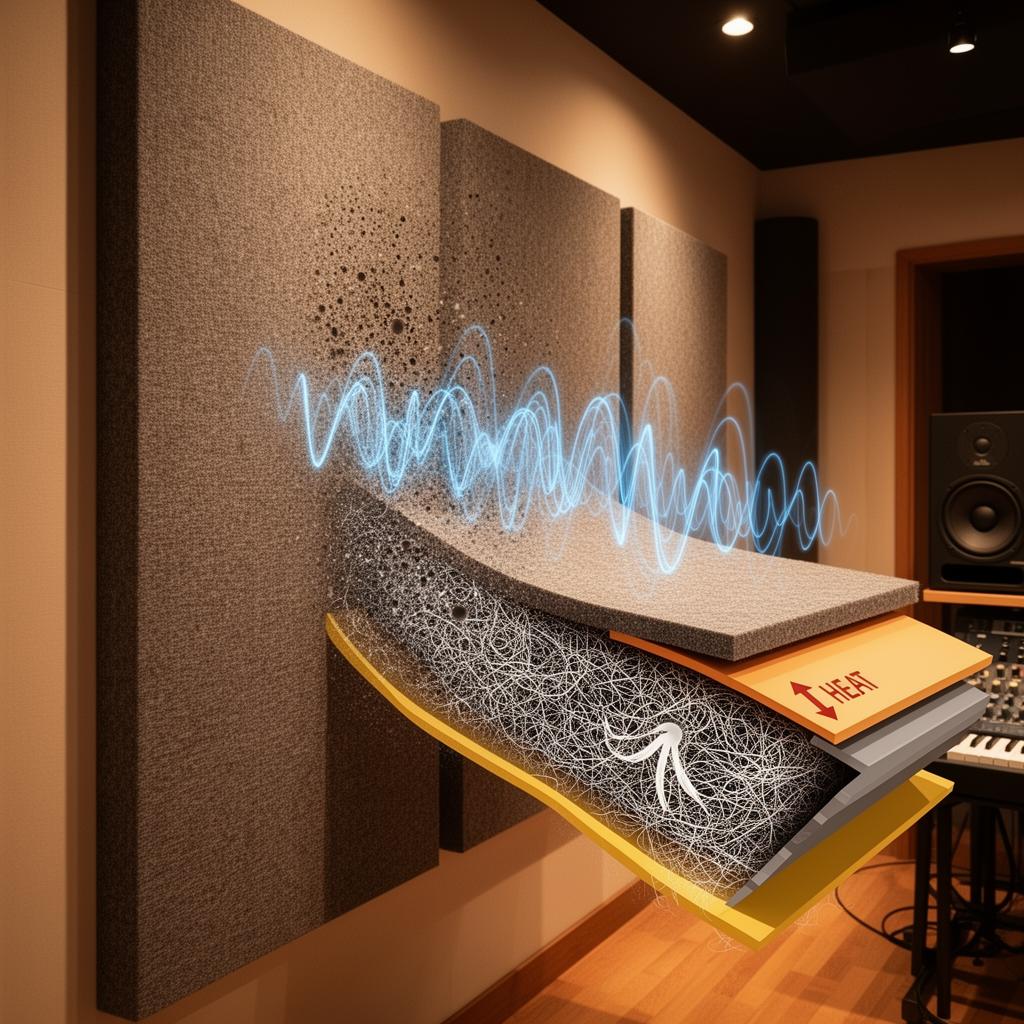
    Fabric-wrapped fiberglass acoustic absorption panels mounted on a recording studio wall with sound waves being absorbed into the porous material
    Fabric-wrapped fiberglass acoustic absorption panels mounted on a recording studio wall with sound waves being absorbed into the porous material

    1What Is Sound Absorption?

    Sound absorption occurs when sound energy enters a material and is converted into a tiny amount of heat through friction, rather than bouncing back into the room as a reflection. Every material absorbs some sound—even concrete absorbs about 2% of the energy that hits it. But purpose-designed acoustic absorbers can capture 80–100% of incident sound energy at specific frequencies.
    Key characteristics of effective absorption:
    Energy removal: Unlike diffusion (which redistributes sound) or soundproofing (which blocks transmission), absorption removes acoustic energy from the room entirely
    Reflection reduction: Absorbers reduce echoes, flutter echo, and reverberation by preventing sound from bouncing between surfaces
    Frequency-dependent: Most absorbers work better at certain frequencies depending on their thickness, density, and mounting method
    Reverberation control: The primary tool for reducing a room's RT60 (reverberation time)—the time it takes for sound to decay by 60 dB

    2How Sound Absorption Works: The Physics

    Sound absorption relies on a simple but elegant physical principle: friction converts kinetic energy to thermal energy.

    Porous Absorption (The Most Common Type)

    When a sound wave enters a porous material—fiberglass, mineral wool, open-cell foam, or heavy fabric—the air molecules carrying the wave are forced to navigate through a labyrinth of tiny interconnected air pockets and fibers. As these molecules oscillate back and forth within the material's structure, they rub against the fibers. This friction converts the sound wave's kinetic energy into an infinitesimally small amount of heat.
    The key factors that determine how much sound a porous absorber captures:
    Thickness: The single most important variable. A thicker absorber captures lower frequencies. As a rule of thumb, an absorber must be at least 1/4 wavelength thick at the lowest frequency you want to absorb. For 500 Hz (wavelength ~27 inches), that's about 7 inches. For 125 Hz (wavelength ~110 inches), you'd need ~27 inches—which is why bass control is so challenging
    Density: Higher density means more fibers per volume, creating more friction. But there's a sweet spot—too dense and the material becomes reflective. Optimal density for fiberglass is typically 2–6 lb/ft³
    Air gap: Mounting an absorber with an air gap behind it dramatically improves low-frequency performance. A 2-inch panel with a 2-inch air gap performs similarly to a 4-inch panel mounted flush
    Flow resistivity: A measure of how easily air passes through the material. Too low = not enough friction. Too high = sound reflects off the surface. The ideal range is 1,000–50,000 rayls/m

    Why Thin Foam Doesn't Absorb Bass

    This is one of the most misunderstood concepts in acoustics. Thin acoustic foam (1–2 inches) only absorbs mid and high frequencies (above ~1,000 Hz). Low-frequency sound waves have long wavelengths and pass through thin materials with minimal friction. A room treated only with thin foam will sound muffled (highs absorbed) and boomy (bass untouched)—the exact opposite of what most people want.

    3The Noise Reduction Coefficient (NRC)

    The Noise Reduction Coefficient (NRC) is the standard metric for rating a material's absorption performance. It's the average of the material's absorption coefficients at 250, 500, 1000, and 2000 Hz, rounded to the nearest 0.05.
    NRC 0.00: Perfectly reflective (no absorption)—polished marble
    NRC 0.05–0.15: Highly reflective—concrete, glass, drywall
    NRC 0.50–0.70: Moderate absorption—heavy curtains, carpet on concrete
    NRC 0.80–0.95: High absorption—2-inch fiberglass panels, thick mineral wool
    NRC 1.00+: Maximum absorption (values above 1.00 occur due to edge diffraction effects in lab testing)

    NRC Ratings of Common Materials

    MaterialNRC Rating
    Concrete0.05
    Drywall (painted)0.05
    Glass window0.10
    Hardwood floor0.10
    Heavy carpet on pad0.55
    Heavy curtains0.55
    2" acoustic foam0.70
    2" fiberglass panel0.85
    4" mineral wool panel0.95
    Important limitation: NRC is a single-number average across only mid frequencies. It tells you nothing about low-frequency performance. A material with an NRC of 0.85 might have excellent absorption at 2,000 Hz but almost none at 125 Hz. Always examine the full frequency-specific absorption coefficient data when designing critical listening spaces.

    4Types of Sound Absorbers

    Acoustic absorbers fall into three categories, each addressing different frequency ranges:

    1. Porous Absorbers (Mid-High Frequencies)

    These are the most common and include fiberglass panels, mineral wool (Rockwool), open-cell acoustic foam, heavy fabric, and carpet. They work through frictional losses as described above. Effectiveness depends primarily on thickness—thicker panels absorb lower frequencies. Typical applications include wall-mounted panels, ceiling clouds, and baffles.

    2. Resonant Absorbers (Low Frequencies)

    Also called panel absorbers or membrane absorbers, these use a vibrating panel or membrane mounted over a sealed air cavity. The panel vibrates at its resonant frequency and converts that specific band of sound energy into heat through internal damping. Helmholtz resonators (perforated panels over a cavity) are a related type that targets a specific narrow frequency band. These are essential for bass traps—controlling low-frequency buildup in room corners.

    3. Hybrid Absorbers (Broadband)

    Combining porous material with a resonant panel creates a broadband absorber that works from low to high frequencies. Many commercial bass traps use this approach: a membrane or slotted panel face backed by a thick cavity filled with mineral wool. This gives strong low-frequency absorption from the resonant mechanism plus mid-high absorption from the porous fill.

    5Absorption vs. Soundproofing: The Critical Difference

    This is the single most important distinction in acoustics, and the one most frequently confused by consumers:
    Sound absorption reduces sound within a room. It makes the room quieter for people inside by reducing reflections and reverberation. An absorber on your wall will make your room sound better—but your neighbor will hear exactly the same amount of noise coming through that wall.
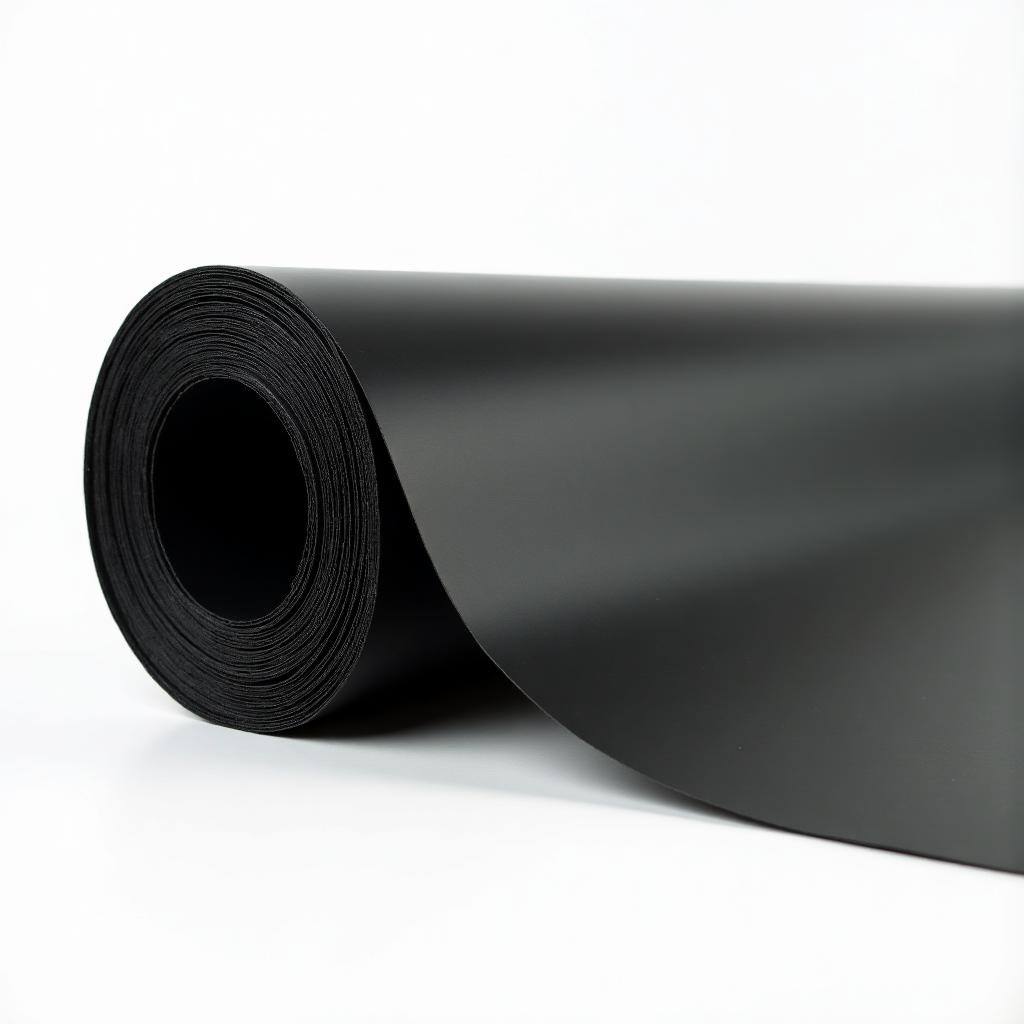
    Soundproofing (sound isolation) prevents sound from traveling between spaces. It requires mass (heavy, dense materials like mass loaded vinyl), decoupling (breaking the physical connection between surfaces so vibrations can't transfer), damping (dissipating vibration energy within structures), and sealing (eliminating air gaps).
    A practical example: If your neighbor's music is too loud:
    Adding acoustic foam to your wall will make YOUR room's echo slightly less harsh, but the music coming through the wall will be just as loud
    Adding mass loaded vinyl inside the wall will actually reduce the music transmission by 15–25+ dB—a dramatic, audible difference
    The four principles of soundproofing (Mass, Damping, Decoupling, Absorption) work together. Mass loaded vinyl provides the critical mass layer that acoustic foam, fiberglass, and carpet simply cannot. At 1 lb per square foot in just 1/8-inch thickness, MLV adds more mass-per-thickness than any other commonly available material—making it the most space-efficient way to add sound-blocking mass to walls, ceilings, floors, and ductwork.

    6Where to Place Absorbers

    Strategic placement matters far more than total coverage. Here's where absorbers have the most impact:

    First Reflection Points

    The most critical absorption placement in any listening room. First reflection points are the spots on walls and ceiling where sound from speakers bounces once before reaching the listener. These early reflections arrive within 5–20 milliseconds of the direct sound and cause comb filtering—destructive interference that creates peaks and dips in the frequency response. Use the "mirror trick": sit in your listening position, have someone slide a mirror along the wall—wherever you can see the speaker in the mirror, that's a first reflection point.

    Room Corners (Bass Traps)

    Low-frequency energy accumulates in corners where walls meet walls, walls meet ceilings, and walls meet floors. Placing thick absorbers (minimum 4 inches, ideally 6+ inches) across corners is the most effective way to control bass buildup and reduce boomy, muddy room acoustics.

    Ceiling

    A ceiling cloud (a suspended absorptive panel directly above the listening or speaking area) controls ceiling reflections that contribute to flutter echo and poor speech intelligibility. Essential in conference rooms, classrooms, and open offices.

    Opposite Parallel Walls

    Parallel walls create flutter echo—a rapid, metallic-sounding repetition most noticeable when clapping in an empty room. Treating at least one of two parallel surfaces with absorption eliminates flutter echo entirely.

    7Common Sound Absorption Materials Compared

    MaterialBest FrequenciesNRC (2")ProsCons
    Fiberglass (rigid board)250 Hz–8 kHz0.85Excellent broadband, fire-ratedRequires fabric wrapping, irritating fibers
    Mineral wool (Rockwool)250 Hz–8 kHz0.90Excellent performance, fire-resistant, moisture-resistantHeavy, requires covering
    Acoustic foam500 Hz–8 kHz0.70Lightweight, easy to install, inexpensivePoor low-freq, degrades in sunlight, fire risk
    Heavy curtains500 Hz–4 kHz0.55Aesthetic, adjustableModerate absorption only, limited low-freq
    Carpet on pad1 kHz–8 kHz0.55Already installed in many roomsHigh-freq only, no wall mounting
    Key takeaway: For serious acoustic treatment, rigid fiberglass board or mineral wool panels (minimum 2 inches thick, ideally 4 inches) mounted with an air gap provide the best broadband absorption per dollar. Acoustic foam is a budget option for mid-high frequencies but should never be relied upon alone.

    8Common Myths About Sound Absorption

    Myth 1: Acoustic foam soundproofs a room

    This is the most widespread misconception in acoustics. Acoustic foam does not soundproof anything. It absorbs mid-high frequency reflections within the room, improving internal sound quality. But it adds virtually zero mass to a wall and does nothing to prevent sound from passing through to adjacent rooms. For actual soundproofing, you need mass (mass loaded vinyl), decoupling, and sealing.

    Myth 2: Egg cartons absorb sound

    Egg cartons have negligible acoustic effect. They're too thin and too rigid to absorb any meaningful amount of sound energy. They scatter a tiny amount of high-frequency sound but provide no absorption below 4,000 Hz. They're also a fire hazard. Don't use them.

    Myth 3: More absorption is always better

    Over-absorbing a room makes it sound dead, lifeless, and uncomfortably dry. Speech becomes strained because you lose the natural room reflections your brain relies on to gauge distance and space. Professional studios target specific reverberation times (0.3–0.5 seconds for control rooms, 0.6–0.8 seconds for live rooms) using a calculated balance of absorption and diffusion—not maximum absorption everywhere.

    Myth 4: Carpet and curtains are sufficient acoustic treatment

    Carpet and curtains only absorb high frequencies (above ~1,000 Hz). A room with only these treatments will sound dark and boomy—the bass buildup remains while the high frequencies are stripped away. Proper treatment requires thick absorbers that address the full frequency spectrum, plus bass traps in corners.

    10Conclusion

    Sound absorption is the foundation of acoustic treatment—but it's only one piece of the puzzle. Absorbers reduce reflections and reverberation within a room, making it sound cleaner and more controlled. But they don't block sound from leaving or entering. For that, you need soundproofing: mass (mass loaded vinyl), decoupling, damping, and sealing. The best acoustic environments combine strategic absorption for internal sound quality, diffusion for natural liveliness, and proper soundproofing with materials like MLV for isolation between spaces. Understanding what each tool does—and what it doesn't—is the difference between a room that sounds professionally treated and one that just has foam on the walls.

    FAQs: What Is Sound Absorption

    Need Expert Soundproofing Advice?

    Our team of soundproofing specialists is here to help you choose the right products and installation methods for your museum or gallery project.