Acoustics & Education26 min readAuthorMass Loaded Vinyl DirectPublishedUpdated

    Characteristics of Sound Waves: Amplitude, Frequency, Wavelength & More
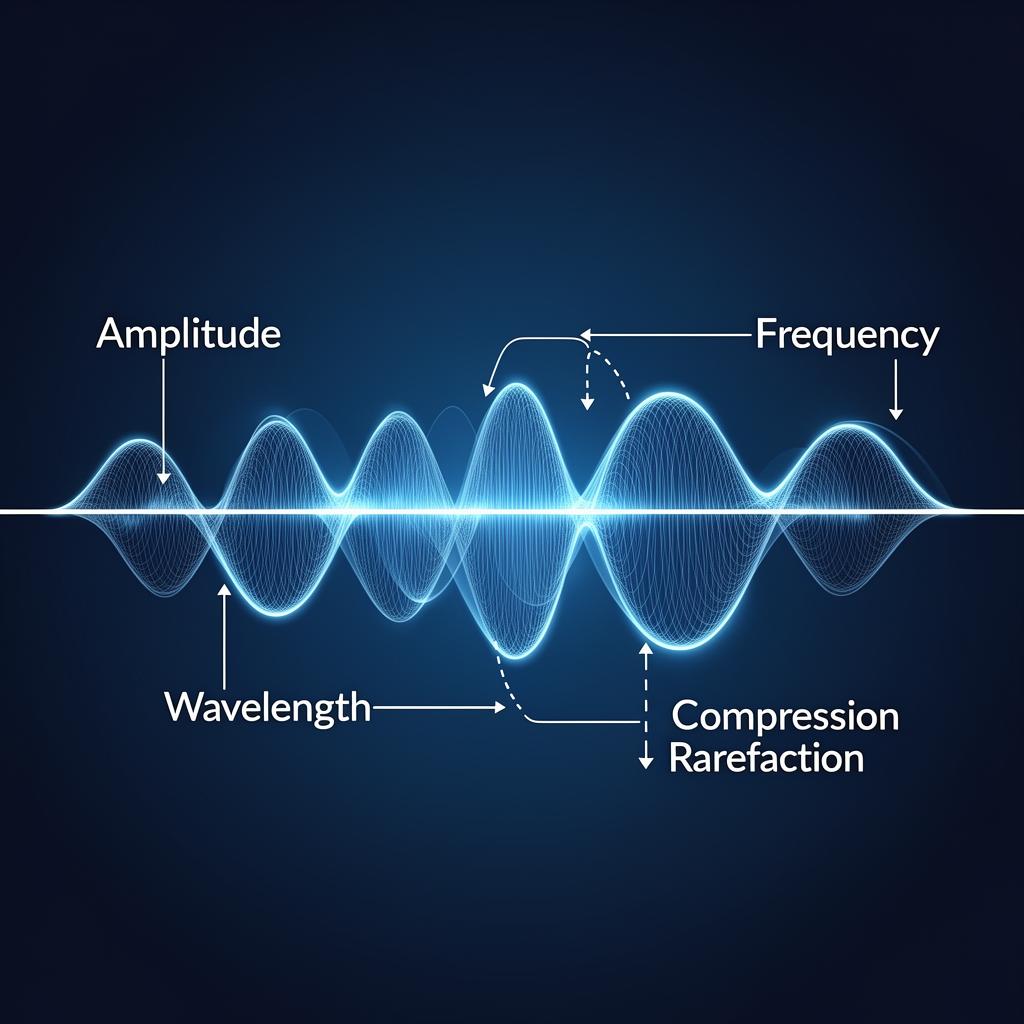
    Scientific diagram showing labeled sound wave characteristics including amplitude, frequency, wavelength, compression and rarefaction zones on a dark blue background
    Scientific diagram showing labeled sound wave characteristics including amplitude, frequency, wavelength, compression and rarefaction zones on a dark blue background

    1What Are Sound Waves?

    A sound wave is a longitudinal mechanical wave—a disturbance that transfers energy through a medium (gas, liquid, or solid) without permanently displacing the medium itself. When an object vibrates, it alternately compresses and decompresses the surrounding molecules, creating pressure variations that radiate outward.

    Compression and Rarefaction

    Every sound wave consists of two alternating phases:
    Compression: A zone where molecules are pushed together, creating localized high pressure above atmospheric normal. On a waveform graph, this corresponds to the peaks (crests) above the center line
    Rarefaction: A zone where molecules are spread apart, creating localized low pressure below atmospheric normal. On a waveform graph, this corresponds to the valleys (troughs) below the center line
    The molecules themselves don't travel from source to listener—each one oscillates around its resting position and transfers energy to its neighbors. It's the pattern of disturbance that travels, not the matter.

    Longitudinal vs. Transverse

    In air and liquids, sound travels exclusively as longitudinal waves—the molecular displacement is parallel to the wave's direction of travel (like compressing and stretching a Slinky). In solids, sound can also propagate as transverse (shear) waves—where displacement is perpendicular to the direction of travel (like a vibrating guitar string).
    This distinction matters in building acoustics: airborne sound hits a wall as a longitudinal wave, sets the wall surface into vibration, and the wall then radiates sound on the other side. But vibrations can also travel through the building structure as both longitudinal and transverse waves—through studs, joists, concrete slabs, and pipes—creating structure-borne noise that bypasses acoustic barriers entirely.

    2Amplitude: The Measure of Loudness

    Amplitude is the maximum displacement of molecules from their equilibrium (resting) position during a wave cycle. It represents the strength of the pressure variation—how forcefully the molecules are being compressed and spread apart.

    Amplitude and Energy

    The energy carried by a sound wave is proportional to the square of its amplitude. This means:
    • Doubling the amplitude quadruples the energy
    • Tripling the amplitude increases energy by 9 times
    • Halving the amplitude reduces energy to one-quarter
    This exponential relationship is why the decibel scale (which measures amplitude as sound pressure level) is logarithmic rather than linear.

    Amplitude and Loudness Perception

    We perceive amplitude as loudness, but the relationship is not perfectly straightforward:
    10 dB increase: Perceived as approximately twice as loud (requires 10× the sound energy)
    3 dB increase: Just barely noticeable to most listeners (requires 2× the sound energy)
    1 dB increase: Imperceptible to most people in real-world conditions
    Common amplitude reference points:
    0 dB SPL: Threshold of human hearing (the quietest detectable sound—20 micropascals of pressure)
    30 dB: Quiet whisper at 5 feet
    60 dB: Normal conversation at 3 feet
    85 dB: Heavy city traffic—prolonged exposure risks hearing damage
    100 dB: Jackhammer, motorcycle—hearing protection required
    120 dB: Threshold of pain—jet engine at 100 meters
    140 dB: Firecracker at ear level—instant hearing damage
    194 dB: Theoretical maximum for sound in Earth's atmosphere (at this point, the rarefaction phase reaches a perfect vacuum)

    Why Amplitude Matters for Soundproofing

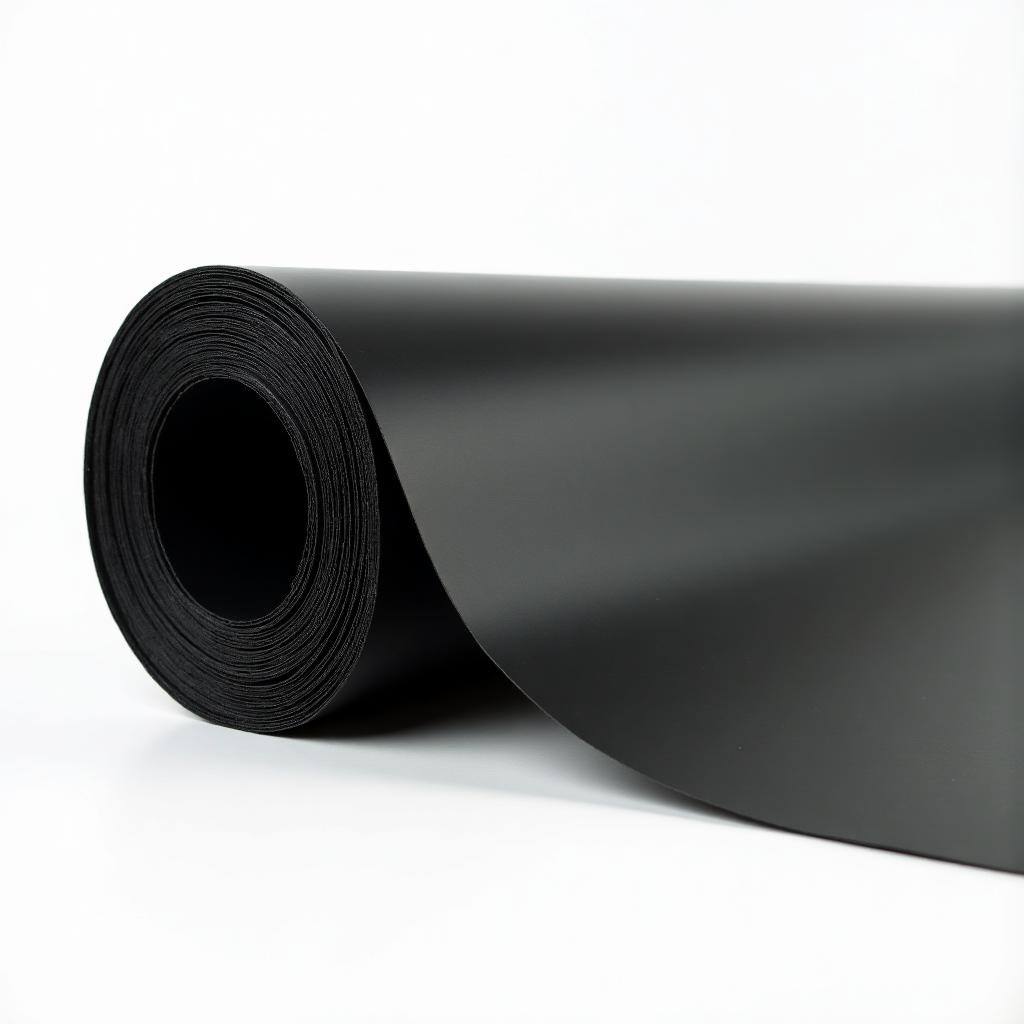
    The higher the amplitude of incoming noise, the more mass and isolation your soundproofing assembly needs. A wall that adequately blocks normal conversation (60 dB) may be completely insufficient against a home theater subwoofer (100+ dB). This is why mass loaded vinyl—with its extraordinary density of 1 lb per square foot in just 1/8" thickness—is essential in high-amplitude environments: it provides the mass needed to resist intense pressure variations without adding excessive bulk.

    3Frequency: The Measure of Pitch

    Frequency is the number of complete wave cycles that pass a fixed point per second. It is measured in Hertz (Hz), where 1 Hz equals one cycle per second.

    Frequency and Pitch

    We perceive frequency as pitch—the musical quality that makes sounds seem "high" or "low":
    20 Hz: The lowest frequency most humans can detect—a deep rumble felt as much as heard
    85 Hz: Low E on a bass guitar
    262 Hz: Middle C on a piano
    440 Hz: Concert A—the universal tuning reference
    1,000 Hz (1 kHz): A bright, clear tone used as a standard reference in acoustics
    4,000 Hz: The approximate peak of human hearing sensitivity—we are naturally most alert to sounds in this range
    10,000 Hz: Sibilant speech sounds ("s," "sh"), cymbal shimmer
    20,000 Hz: The upper limit of human hearing—most adults cannot hear above 15,000 Hz

    Frequency Ranges in Music and Speech

    Sub-bass (20–60 Hz): Kick drum fundamental, pipe organ pedal tones, earthquake rumble
    Bass (60–250 Hz): Bass guitar, male voice fundamental, room rumble
    Low-mid (250–500 Hz): Body of vocals and most instruments, warmth region
    Mid (500–2,000 Hz): Speech clarity region, most musical melodic content
    Upper-mid (2,000–4,000 Hz): Presence, attack, consonant clarity—the "intelligibility" range
    Treble (4,000–10,000 Hz): Brilliance, air, sibilance, cymbal sparkle
    Ultra-treble (10,000–20,000 Hz): Airiness, extreme harmonics, hearing test range

    Frequency and Soundproofing Performance

    This is where frequency becomes critically important for noise control. Low frequencies are dramatically harder to block than high frequencies:
    • A 50 Hz bass tone has a wavelength of ~22 feet—it bends around obstacles, passes through gaps, and sets large surfaces into sympathetic vibration
    • A 4,000 Hz speech consonant has a wavelength of ~3.4 inches—it is easily blocked by mass and reflected by hard surfaces
    The Mass Law predicts that transmission loss increases by ~6 dB for each doubling of frequency at a given mass. This means a wall that blocks 40 dB at 1,000 Hz blocks only ~28 dB at 125 Hz
    This frequency-dependent performance is why your neighbor's bass-heavy music comes through the wall while their conversation does not—and why effective bass blocking requires significantly more mass, deeper cavities, and better decoupling than mid/high-frequency isolation.

    4Wavelength: The Physical Size of Sound

    Wavelength (λ) is the physical distance between two consecutive compressions (or two consecutive rarefactions) in a sound wave. It is inversely proportional to frequency—higher frequencies have shorter wavelengths, and vice versa.

    Wavelength Examples at Room Temperature

    At the speed of sound in air (~1,130 ft/s or 344 m/s at 68°F):
    20 Hz: λ = 56.5 feet (17.2 m)—longer than a semi-truck
    50 Hz: λ = 22.6 feet (6.9 m)—the width of a large living room
    100 Hz: λ = 11.3 feet (3.4 m)—floor-to-ceiling in most rooms
    250 Hz: λ = 4.5 feet (1.4 m)—about the height of a child
    500 Hz: λ = 2.3 feet (0.69 m)
    1,000 Hz: λ = 1.13 feet (0.34 m)—about the length of a ruler
    4,000 Hz: λ = 3.4 inches (8.6 cm)—about the width of a smartphone
    10,000 Hz: λ = 1.4 inches (3.4 cm)
    20,000 Hz: λ = 0.68 inches (1.7 cm)—smaller than a coin

    Why Wavelength Matters Practically

    Wavelength determines how sound interacts with objects and barriers:
    Diffraction: Sound waves bend around obstacles that are smaller than their wavelength. Bass (long wavelength) bends freely around corners, walls, and furniture. Treble (short wavelength) travels more directionally and is easily shadowed by objects
    Absorption: An acoustic absorber must be a significant fraction of the wavelength to be effective. A 2" foam panel absorbs well at 2,000 Hz (λ = 6.8") but is nearly transparent to 100 Hz (λ = 11.3 feet). Effective bass absorption requires panels 4-6" thick or specialized bass traps
    Room modes: Standing wave patterns form when a room dimension equals a half-wavelength (or multiples thereof). A room 11.3 feet wide will have a strong resonance at 50 Hz, causing boomy bass at certain positions and thin bass at others

    5The Wave Equation: Connecting Speed, Frequency & Wavelength

    The three core properties of any wave are linked by the fundamental wave equation:
    v = f × λ
    Where: v = velocity (speed of sound in the medium), f = frequency in Hz, λ = wavelength in meters (or feet).

    Practical Applications

    This equation lets you calculate any property if you know the other two:
    Finding wavelength: λ = v / f. At 344 m/s, a 500 Hz tone has λ = 344/500 = 0.688 m (2.26 ft)
    Finding frequency: f = v / λ. A wave with λ = 1.72 m in air has f = 344/1.72 = 200 Hz
    Finding speed: v = f × λ. A 1,000 Hz tone with λ = 1.5 m is traveling through a medium at 1,500 m/s (water)

    Speed of Sound in Different Media

    The speed of sound varies dramatically by medium—this is why sound transmits so efficiently through building structures:
    Air (68°F): 1,130 ft/s (344 m/s)
    Water: 4,800 ft/s (1,480 m/s)—4.3× faster
    Wood: 8,200-13,000 ft/s (2,500-4,000 m/s) depending on species and grain direction
    Concrete: 9,800-11,500 ft/s (3,000-3,500 m/s)
    Steel: 16,400 ft/s (5,000 m/s)—14.5× faster than air
    Glass: 18,000 ft/s (5,500 m/s)
    When sound travels from air into a solid wall, the frequency stays the same but the wavelength changes proportionally to the new speed. A 100 Hz tone with a wavelength of 11.3 feet in air has a wavelength of ~164 feet in steel. This wavelength change is why sound behaves so differently inside building materials than in the air.

    6Timbre: Why Instruments Sound Different

    Timbre (pronounced "TAM-ber") is the quality that distinguishes two sounds of identical pitch and loudness. It's why a piano playing middle C sounds completely different from a violin playing the same note at the same volume.

    The Physics of Timbre: Harmonics and Overtones

    When a musical instrument plays a note, it doesn't produce a single pure frequency. It generates a fundamental frequency (which determines the perceived pitch) plus a series of harmonics (also called overtones)—additional frequencies at integer multiples of the fundamental:
    Fundamental (1st harmonic): 440 Hz (concert A)
    2nd harmonic: 880 Hz
    3rd harmonic: 1,320 Hz
    4th harmonic: 1,760 Hz
    5th harmonic: 2,200 Hz
    • And so on...
    The relative amplitudes of these harmonics create each instrument's unique "sonic fingerprint":
    Flute: Strong fundamental with weak harmonics—sounds pure and clear
    Clarinet: Strong odd-numbered harmonics (3rd, 5th, 7th)—creates its distinctive hollow quality
    Violin: Rich mix of many harmonics—complex, warm sound
    Trumpet: Strong upper harmonics—bright, cutting quality
    Human voice: Extraordinarily complex harmonic structure unique to each individual—no two voices are alike

    Timbre in Noise Control

    Timbre matters for soundproofing because different instruments and noise sources distribute energy across the frequency spectrum differently. A piano generates significant energy from 27.5 Hz (lowest A) to over 4,000 Hz. A kick drum concentrates energy around 50-80 Hz. An HVAC system produces broadband noise with emphasis on low frequencies. Your soundproofing solution must address the specific spectral profile of the noise source—not just its overall volume.

    Envelope: Attack, Decay, Sustain, Release

    Timbre is also shaped by a sound's temporal envelope—how its amplitude changes over time:
    Attack: How quickly the sound reaches full volume (a snare drum has a sharp attack; a bowed cello has a slow attack)
    Decay: The initial decrease after the attack peak
    Sustain: The steady-state level while the sound is held
    Release: How quickly the sound fades after the source stops
    Impact sounds (footsteps, door slams, dropped objects) have sharp attacks that create structure-borne vibrations. Sustained sounds (music, speech, HVAC) create continuous airborne pressure. Each requires different soundproofing strategies.

    7Phase: When Waves Align or Cancel

    Phase describes the position of a point within a wave cycle, measured in degrees (0° to 360° for one complete cycle) or radians. Phase becomes critically important when two or more waves interact.

    Phase Relationships

    In phase (0° difference): Two waves with identical frequency and phase align perfectly—their compressions and rarefactions coincide, and the combined amplitude doubles (+6 dB). This is constructive interference
    Out of phase (180° difference): The compression of one wave aligns with the rarefaction of the other—they cancel each other, potentially resulting in silence. This is destructive interference
    Partial phase differences: Most real-world interactions involve complex partial phase relationships that produce reinforcement at some frequencies and cancellation at others

    Phase in Acoustic Design

    Phase interactions create many real-world acoustic phenomena:
    Comb filtering: When a direct sound combines with a delayed reflection, certain frequencies cancel and others reinforce, creating a hollow, metallic quality. This commonly occurs when a microphone picks up both direct speech and a reflection from a desk or table
    Active noise cancellation: Headphones and vehicle cabin systems generate sound waves that are 180° out of phase with incoming noise, creating destructive interference that cancels the unwanted sound
    Speaker placement: Placing a subwoofer against a wall reinforces bass (the wall acts as a mirror, creating a virtual "second speaker" nearly in phase) while corner placement adds even more reinforcement

    8Reflection of Sound Waves

    When a sound wave encounters a surface, some energy bounces back into the original space. This is reflection, and it follows the same law as light: the angle of incidence equals the angle of reflection.

    Types of Reflection

    Specular reflection: Occurs on smooth, flat surfaces (glass, polished concrete, drywall). Sound bounces at a predictable angle, like a billiard ball off a cushion. Creates clear echoes and focused hot spots
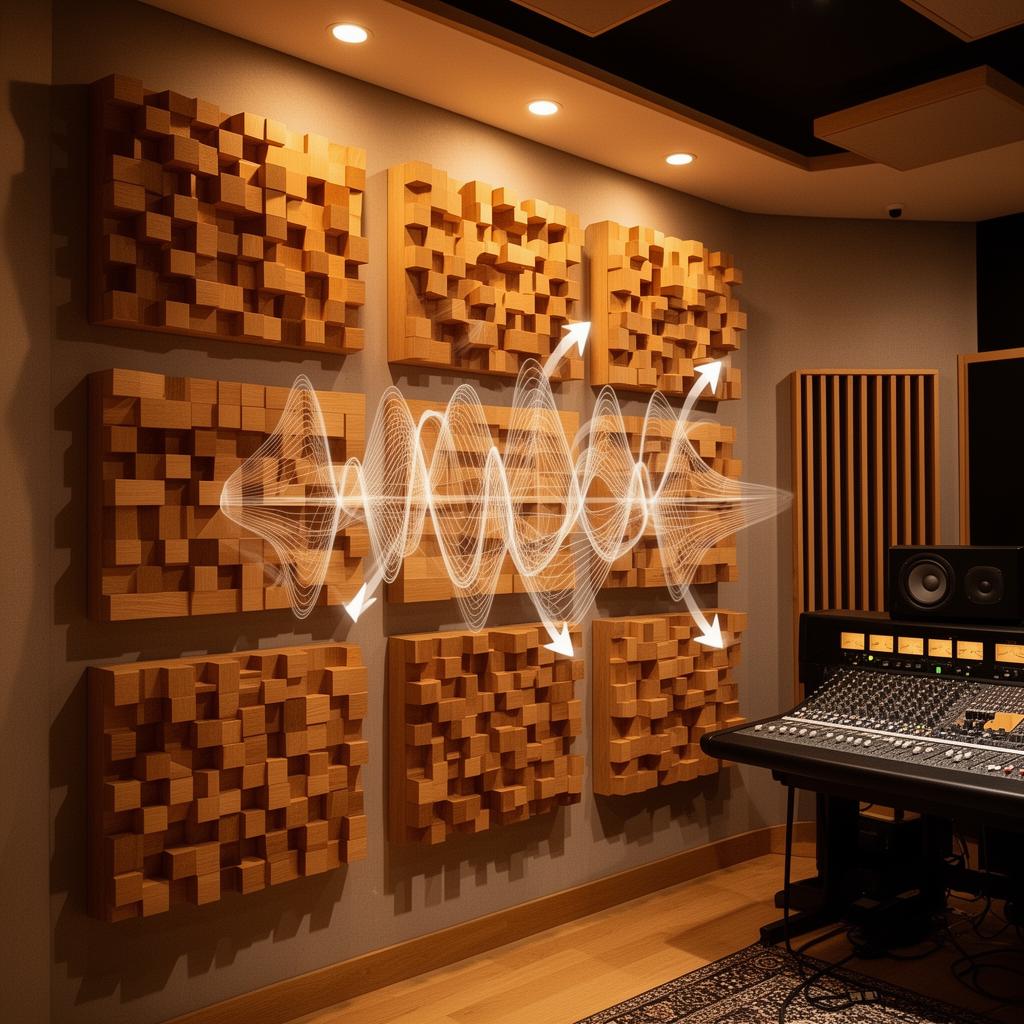
    Diffuse reflection: Occurs on irregular, textured surfaces (stone walls, bookshelves, acoustic diffusers). Sound scatters in many directions, creating an even, spacious sound field without harsh echoes

    Acoustic Phenomena Caused by Reflection

    Echo: A distinct, delayed repetition of a sound. Requires at least 50-80 feet between source and reflecting surface (the sound must travel far enough for the brain to perceive it as a separate event—about 1/15th of a second delay)
    Reverberation: The sustained wash of many overlapping reflections that gradually decay. Measured as RT60—the time for sound to decay by 60 dB. A concert hall might have RT60 of 1.5-2.5 seconds; a recording studio targets 0.3-0.5 seconds
    Flutter echo: Rapid, metallic-sounding repetitions caused by sound bouncing between two parallel hard surfaces. Common in hallways, stairwells, and rooms with bare walls facing each other
    SONAR: Sound Navigation And Ranging uses reflection to detect underwater objects—the same principle dolphins and bats use naturally

    Controlling Reflection

    Acoustic treatment controls reflection through two strategies: absorption (converting reflected energy into heat using porous materials) and diffusion (scattering reflected energy evenly using shaped surfaces). In most rooms, a combination of both creates the optimal acoustic environment.

    9Refraction of Sound Waves

    Refraction is the bending of sound waves when they pass between media of different densities or when temperature/wind gradients exist within the same medium.

    Temperature-Based Refraction

    Sound travels faster in warmer air. When air temperature varies with height, sound waves bend:
    Normal daytime conditions: Air is warmer near the ground and cooler at altitude. Sound waves bend upward, away from the ground, making distant sounds harder to hear
    Temperature inversion (nighttime, over water): Cooler air near the ground, warmer above. Sound bends downward, hugging the surface, allowing sounds to travel remarkable distances. This is why you can hear conversations across a lake at night

    Wind-Based Refraction

    Wind speed typically increases with altitude. This creates a velocity gradient that bends sound:
    Downwind: Sound curves downward toward the ground—sounds carry farther
    Upwind: Sound curves upward away from the ground—creating a "shadow zone" where noise is significantly reduced

    Refraction Between Media

    When sound passes from one medium to another (air to glass, air to water), its speed changes while frequency remains constant. This speed change causes the wavefront to bend at the interface—exactly like light bending through a prism. In building acoustics, refraction at air-solid interfaces is one mechanism by which sound energy enters wall assemblies.

    10Diffraction of Sound Waves

    Diffraction is the ability of sound waves to bend around obstacles and spread through openings. It's the reason you can hear someone speaking around a corner even when you have no line of sight.

    The Wavelength Rule

    Diffraction is most pronounced when the obstacle or opening is similar in size to or smaller than the wavelength:
    Low frequencies (long wavelengths): Bend freely around most obstacles. A 100 Hz tone (λ = 11 feet) diffracts around walls, furniture, and barriers as if they weren't there
    High frequencies (short wavelengths): Travel more directionally and are easily "shadowed" by obstacles. A 10,000 Hz tone (λ = 1.4 inches) can be blocked by something as small as your hand

    Diffraction in Real Life

    Noise barriers along highways: Effective at blocking mid and high-frequency traffic noise, but bass rumble diffracts over the top, which is why you can still "feel" highway noise behind a barrier
    Doors and windows: Sound diffracts through even small gaps and cracks. A crack under a door acts as a secondary sound source, radiating noise into the adjacent room
    Thunder: Close lightning strikes sound sharp and crackling (all frequencies arrive). Distant strikes sound like deep, rolling rumbles because the high frequencies have been absorbed by the atmosphere while the low frequencies diffract over terrain and through the air unimpeded

    Diffraction and Soundproofing

    Diffraction explains why bass is so difficult to contain. Low-frequency sound waves literally bend around barriers that would block higher frequencies. Effective bass soundproofing requires massive, continuous barriers with no gaps—exactly what mass loaded vinyl provides when properly sealed at all seams and edges.

    11Interference: Constructive and Destructive

    When two or more sound waves occupy the same space, they superimpose—their pressure variations add together mathematically at every point. This is the principle of superposition, and it produces interference patterns.

    Constructive Interference

    When wave compressions align with compressions (and rarefactions with rarefactions), the resulting amplitude is greater than either individual wave. Maximum constructive interference occurs when waves are perfectly in phase, doubling the amplitude (+6 dB).
    Real-world examples:
    Room corners: Sound reflecting off two or three perpendicular surfaces creates constructive interference at certain frequencies, causing "bass buildup" in corners
    Parallel walls: At frequencies where the room width equals a half-wavelength, standing waves create zones of maximum pressure (antinodes) and minimum pressure (nodes)

    Destructive Interference

    When compressions align with rarefactions, the waves cancel each other. Perfect destructive interference (180° out of phase, equal amplitude) produces silence.
    Real-world examples:
    Active noise cancellation: The defining technology of modern noise-cancelling headphones. Microphones detect incoming noise, a processor generates an inverted (180°) copy, and speakers play it simultaneously to cancel the original
    Dead spots in rooms: Positions where reflected waves destructively interfere with direct sound at specific frequencies. You may notice certain bass notes "disappear" when you move to particular positions in a room

    Beating

    When two waves of slightly different frequencies interfere, they produce beats—a periodic pulsation in volume. The beat frequency equals the difference between the two frequencies. If one tuning fork vibrates at 440 Hz and another at 442 Hz, you hear 2 beats per second. Musicians use this phenomenon to tune instruments: when the beating stops, the frequencies match perfectly.

    12Resonance and Standing Waves

    Resonance occurs when a system is driven at one of its natural frequencies, causing vibrations to build dramatically in amplitude. Every physical object—a wine glass, a guitar string, a room, a wall—has natural frequencies determined by its mass, stiffness, and dimensions.

    Standing Waves

    When sound reflects between two parallel surfaces, the incident and reflected waves can combine to form a standing wave—a pattern that appears stationary rather than traveling. Standing waves have:
    Nodes: Fixed points of minimum amplitude (destructive interference)
    Antinodes: Fixed points of maximum amplitude (constructive interference)
    The lowest frequency at which a standing wave can form between two surfaces is called the fundamental mode. Its wavelength equals twice the distance between the surfaces. Higher-order modes (harmonics) occur at integer multiples of the fundamental.

    Room Modes

    In rectangular rooms, standing waves form between every pair of parallel surfaces, creating three sets of room modes:
    Axial modes: Between two parallel surfaces (most powerful, easiest to predict)
    Tangential modes: Involving four surfaces (half the energy of axial modes)
    Oblique modes: Involving all six surfaces (quarter energy, most complex)
    These modes cause certain bass frequencies to be dramatically louder at some positions (corners, wall centers) and nearly inaudible at others. This is why a subwoofer can sound overpowering in one spot and thin three feet away.

    Resonance in Soundproofing

    Every wall, floor, and ceiling assembly has a resonant frequency where it vibrates most freely and transmits the most sound. For a typical single-stud wall with drywall, this is usually between 50-100 Hz. At this frequency, the wall essentially acts as a loudspeaker, converting airborne sound on one side into airborne sound on the other with minimal loss.
    The solution is to increase mass (which lowers the resonant frequency below the audible range) and add damping (which reduces the amplitude of resonant vibration). Mass loaded vinyl excels at both: its weight shifts the resonant frequency lower, and its limp, non-rigid molecular structure provides natural damping that rigid materials like additional drywall cannot match.

    13How Sound Wave Characteristics Affect Soundproofing

    Every characteristic discussed in this guide has direct, measurable implications for noise control. Here's how they connect:

    Amplitude → Mass Requirements

    Higher-amplitude noise sources require more massive barriers. A wall that blocks conversation (60 dB) needs only STC 35-40. A wall next to a home theater (100+ dB peak) needs STC 55-60+ to achieve the same perceived silence. Mass loaded vinyl delivers the highest mass-per-thickness ratio of any common soundproofing material.

    Frequency → Material Selection

    Low-frequency noise demands different solutions than high-frequency noise:
    Bass (20-250 Hz): Requires maximum mass, deep air cavities, and full decoupling. MLV + double drywall + resilient channels + insulation
    Mid frequencies (250-4,000 Hz): Addressed well by mass alone. Single layer of MLV can add 25+ STC points
    High frequencies (4,000+ Hz): Blocked by relatively lightweight materials and sealed gaps

    Wavelength → Gap Sensitivity

    Long wavelengths diffract through gaps more readily. The 1% gap rule (1% opening leaks 50% of sound energy) is especially devastating for bass. Every electrical outlet, HVAC penetration, and door gap must be sealed with acoustic caulk and putty pads for effective low-frequency control.

    Resonance → Assembly Design

    Single-material barriers have coincidence frequencies where transmission loss drops dramatically. Multi-layer assemblies with different materials (MLV + drywall + insulation) ensure no single frequency passes through unimpeded.

    Reflection → Interior Acoustics

    Sound that enters a room reflects off hard surfaces, creating reverberation that makes spaces feel louder than the actual transmitted noise level. Combining soundproofing (blocking) with acoustic treatment (absorption) addresses both the amount of noise entering and the perception of that noise within the space.

    16Conclusion

    Sound waves are defined by a set of measurable, predictable characteristics—amplitude, frequency, wavelength, timbre, phase, and their interactions through reflection, refraction, diffraction, interference, and resonance. Understanding these properties transforms soundproofing from guesswork into science. Every acoustic decision—from choosing wall assemblies to selecting insulation to sealing gaps—can be traced back to these fundamental wave characteristics. At Mass Loaded Vinyl Direct, our products are engineered with these exact principles in mind. MLV's extreme density-per-thickness addresses the mass requirements that amplitude demands. Its limp, non-resonant structure provides damping that prevents coincidence-frequency transmission loss. And its flexible, continuous barrier format enables the gap-free installation that wavelength-driven diffraction requires. Whether you're soundproofing a home theater, specifying assemblies for a multifamily project, or simply trying to understand why bass comes through your walls, the physics of sound waves has the answer.

    FAQs: Characteristics of Sound Waves

    Need Expert Soundproofing Advice?

    Our team of soundproofing specialists is here to help you choose the right products and installation methods for your museum or gallery project.