School Soundproofing with Mass Loaded Vinyl (MLV)
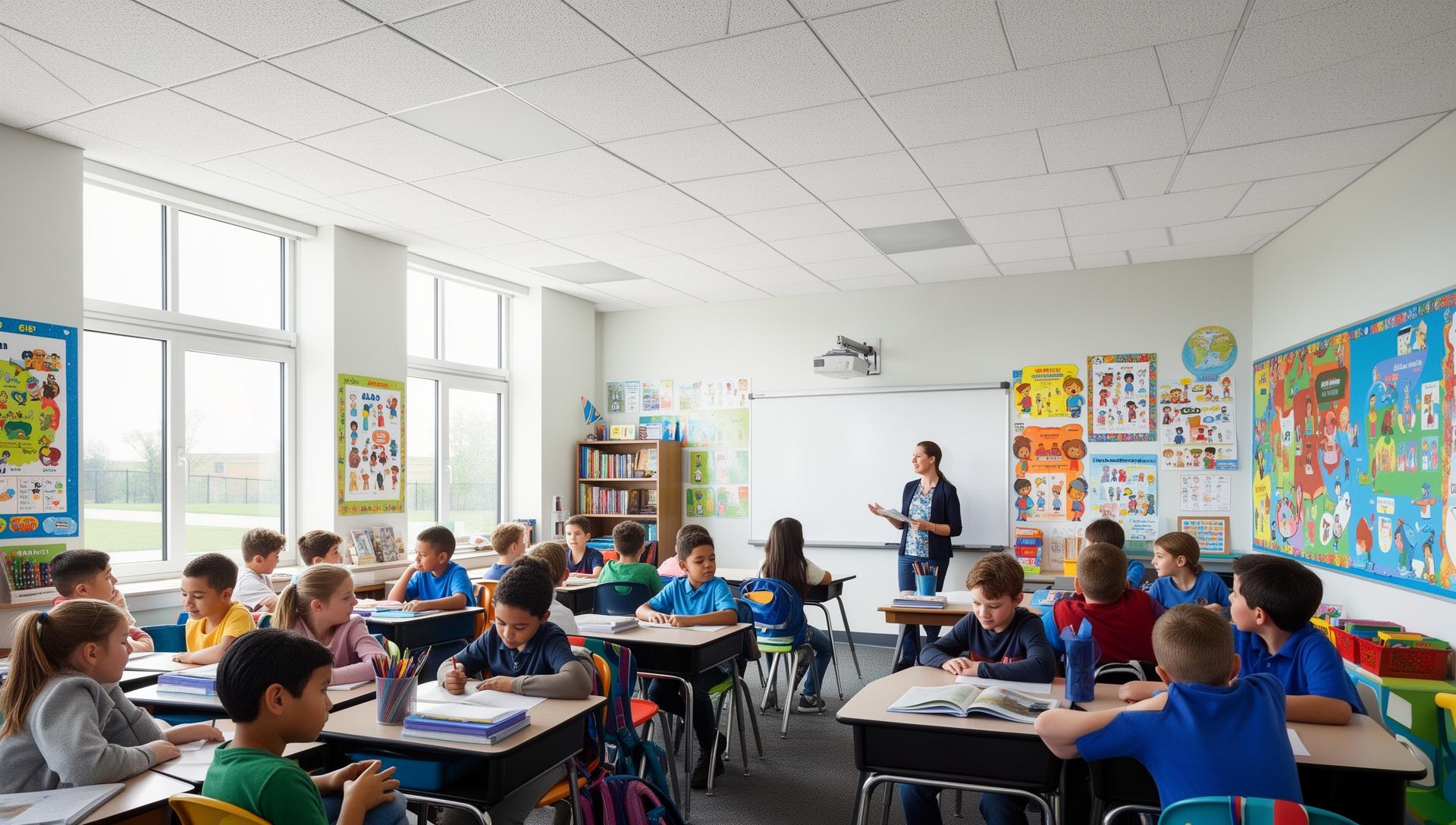
1Why School Acoustics Matter for Learning
The Research on Classroom Noise
• Reading development: Children learning to read in noisy environments show delayed phonemic awareness development critical to literacy
• Attention and behavior: Background noise increases off-task behavior by 40% in elementary students
• Teacher voice strain: Teachers in acoustically poor classrooms have 3x higher rates of voice disorders requiring medical treatment
• Special needs impact: Students with hearing impairments, ADHD, autism, and English language learners are disproportionately affected by poor acoustics
Educational Equity Concerns
• Deferred maintenance: HVAC systems in underfunded schools generate excessive noise from worn equipment
• Open plan classrooms: 1970s-era open schools lack walls entirely, requiring expensive renovation for modern learning
• Urban locations: Schools near highways, airports, and industrial areas face external noise challenges
• Portable classrooms: Temporary buildings often have minimal acoustic isolation from exterior noise and adjacent units
The Economic Case for School Soundproofing
• Reduced teacher turnover: Teachers report higher job satisfaction in acoustically appropriate spaces
• Special education costs: Proper acoustics can reduce the need for costly specialized instruction for some students
• Building longevity: Acoustic improvements often accompany energy efficiency upgrades that reduce operating costs
2ANSI S12.60 Classroom Acoustic Standards
Background Noise Requirements
• Core learning spaces (10,000-20,000 ft³): Maximum 40 dBA background noise
• Ancillary spaces: Maximum 45 dBA for corridors, cafeterias, and gymnasiums
• Measurement conditions: Measured with HVAC operating normally and no occupants present
Reverberation Time Requirements
• Core learning spaces (10,000-20,000 ft³): Maximum 0.7 second RT60
• Ancillary spaces: No specific requirement but general recommendations for speech intelligibility
Sound Isolation Requirements
• Classroom to corridor: STC 45 minimum with acoustic door assemblies
• Classroom to noisy spaces: STC 60+ required when adjacent to music rooms, gymnasiums, or mechanical spaces
• Exterior walls: OITC ratings must ensure interior noise limits are met despite exterior noise sources
Adoption and Enforcement
• District requirements: Some school districts exceed state requirements with stricter acoustic standards
• Federal compliance: Schools receiving federal funding may have additional accessibility requirements
• Verification testing: Post-construction acoustic testing may be required to verify compliance
3Core Classroom Soundproofing Requirements
Wall Assembly Design
• Enhanced approach: Adding 1 lb/sf MLV to the assembly achieves STC 55-58 for adjacent noisy spaces
• Staggered stud: Staggered studs on wide plate improve STC without adding wall thickness
• Resilient channel: One side on resilient channel adds 5-7 STC points cost-effectively
Ceiling Treatment
• CAC ratings: Ceiling Attenuation Class (CAC) indicates sound blocking—specify CAC 35+ for classrooms
• Plenum barriers: When walls don't extend to structure, MLV ceiling barriers prevent sound flanking
• Full-height walls: For best isolation, extend walls to the deck with MLV and insulation
Door Assemblies
• Acoustic seals: Full perimeter gaskets and automatic door bottoms are essential
• Rated assemblies: STC 40+ doors are available for high-isolation applications
• Vision panels: Glazing in doors must use acoustic laminated glass to maintain STC ratings
HVAC Noise Control
• Duct lining: Internal acoustic lining reduces airborne noise transmission
• Silencers: Duct silencers near classrooms reduce fan and air turbulence noise
• Vibration isolation: Air handlers and other equipment on isolators prevent structure-borne noise
4Music Room and Band Hall Isolation
Understanding Music Room Sound Levels
• Marching band: 100-115 dB with drums and brass in enclosed rehearsal spaces
• Orchestra: 85-100 dB with wide frequency range
• Choir: 80-95 dB, primarily mid-range frequencies easier to isolate
• Practice rooms: Individual practice can reach 95-105 dB for percussion and amplified instruments
Wall Assembly Requirements
• CMU with furring: Concrete block with furring channels, insulation, MLV, and drywall achieves STC 55-62
• Full-height construction: Walls must extend from slab to structure—no stopping at ceiling grid
• Flanking prevention: All penetrations, ductwork, and electrical must be acoustically sealed
Practice Room Design
• Door assemblies: STC 45-50 doors with double seals and acoustic thresholds
• Vision panels: Laminated acoustic glass for supervision while maintaining isolation
• Ventilation: Silenced fresh air supply that doesn't create duct crosstalk between rooms
MLV Applications for Music Facilities
• Ceiling barriers: MLV above suspended ceilings prevents sound travel through plenum spaces
• Duct wrapping: MLV-wrapped ductwork near music rooms prevents sound transmission to quiet spaces
• Door upgrades: MLV-lined door cores or surface-applied MLV can upgrade existing doors
5Gymnasium and Cafeteria Challenges
The Reverberation Problem
• Large volumes: High ceilings and open floor plans create reverberation times of 3-5+ seconds
• Occupancy noise: Hundreds of students generate cumulative noise that becomes deafening
• Speech intelligibility: Announcements and instructions become unintelligible without treatment
Absorption Requirements
• Wall panels: Impact-resistant acoustic panels on walls reduce flutter echo between parallel surfaces
• Target RT60: 1.0-1.5 seconds is achievable with comprehensive treatment
• NRC requirements: Use panels with NRC 0.85+ for effective absorption
Isolation from Academic Spaces
• Impact isolation: Gyms above classrooms need IIC 55+ floor/ceiling assemblies
• Schedule coordination: When isolation is impossible, scheduling can separate noisy and quiet activities
• MLV in walls: Adding 2 lb/sf MLV to demising walls achieves required isolation levels
Kitchen Noise Considerations
• Serving line openings: Pass-through windows need closable shutters with acoustic seals
• Exhaust systems: Kitchen exhaust can transmit noise to exterior play areas or neighbors
6Library and Media Center Acoustics
The Quiet Study Challenge
• Group collaboration: Many libraries include group study rooms for team projects
• Computer labs: Technology areas generate equipment noise and conversation
• Maker spaces: Some libraries include noisy maker activities that must be isolated
• Media production: Video and podcast recording requires exceptional quiet
Background Noise Requirements
• Group rooms: NC 35-40 with isolation from main library space
• Computer areas: NC 40-45 acceptable with equipment noise contribution
• Recording spaces: NC 20-25 required for quality audio production
Isolation Strategies
• Adjacent to cafeteria: STC 50-55 with attention to noise during lunch periods
• Adjacent to corridors: STC 45-50 with acoustic entry vestibules if possible
• Group study rooms: STC 45-50 glazed partitions with acoustic glass
Flexible Acoustic Design
• Furniture as barriers: High-back seating and shelving units provide informal acoustic separation
• Sound masking: Electronic masking systems can increase speech privacy in open areas
• Zone planning: Locate noisy and quiet functions to minimize conflicts
7Special Education and Testing Rooms
Special Education Acoustic Needs
• Autism spectrum: Many autistic students are hypersensitive to noise and require quiet, predictable acoustic environments
• ADHD: Background noise significantly impacts attention for students with attention deficits
• Processing disorders: Auditory processing disorders require optimal signal-to-noise ratios for comprehension
• Speech therapy: Therapy rooms require low reverberation for accurate sound perception and production
Enhanced Standards for Special Spaces
• Reverberation: Target RT60 0.4-0.5 seconds instead of 0.6 seconds maximum
• Sound isolation: STC 55+ walls instead of minimum STC 50 for enhanced quiet
• HVAC systems: Premium low-noise equipment and silencing for mechanical systems
Standardized Testing Facilities
• Distraction-free: Students must not be disturbed by adjacent activities during testing
• Consistent conditions: All testing locations should have equivalent acoustic quality for fairness
• Accommodation spaces: Extended time and separate testing rooms need equivalent or better acoustics
Resource Room Design
• Flexible partitions: Acoustic dividers can separate activities within larger spaces
• Sensory considerations: Some students need quiet sensory spaces with minimal stimulation
• Technology integration: Audio equipment for therapy and instruction requires controlled acoustics
8MLV Installation Strategies for Schools
New Construction Applications
• Gymnasium demising: MLV in walls separating gymnasium from classrooms achieves required STC
• Mechanical room isolation: MLV in walls and ceilings around mechanical spaces controls equipment noise
• Ceiling plenums: MLV barriers above suspended ceilings prevent sound flanking throughout building
Renovation and Retrofit
• Ceiling barriers: Installing MLV above existing ceiling grids addresses flanking paths
• Partition upgrades: Adding MLV to existing partitions can bring old buildings closer to ANSI S12.60
• Phased renovation: MLV upgrades can be prioritized by room use and acoustic deficiency
Fire and Safety Compliance
• Smoke development: Use fire-rated MLV products with appropriate smoke development ratings
• Seismic requirements: Ceiling installations must meet seismic bracing requirements in applicable zones
• ADA compliance: Acoustic improvements must not compromise accessibility features
Cost-Effective Strategies
• Standard assemblies: Develop standard wall types that can be specified consistently across projects
• Combination approaches: Combine MLV with resilient channel and insulation for cost-effective STC improvements
• Long-term savings: Consider reduced special education referrals and improved learning outcomes when evaluating costs
10Conclusion
School soundproofing is not a luxury—it's a fundamental requirement for effective education. The research is clear: students in acoustically appropriate classrooms learn better, test higher, and experience fewer behavioral issues than those in noisy environments.
Mass loaded vinyl plays a critical role in meeting ANSI S12.60 standards, particularly for challenging adjacencies like music rooms next to classrooms or gymnasiums near libraries. Its thin profile and proven STC performance make it the go-to solution for school architects and contractors who must achieve high acoustic ratings within tight education budgets.
Whether you're designing a new school or renovating an existing facility, prioritizing acoustics delivers measurable improvements in student outcomes that justify the investment many times over.
FAQs: School Soundproofing
Related Guides in Industry Solutions
Continue exploring with these hand-picked articles
Courthouse Soundproofing with Mass Loaded Vinyl (MLV)
Complete guide to soundproofing courthouses, courtrooms, and legal facilities with mass loaded vinyl. Ensure speech privacy for attorney-client communications, protect witness identities, and create optimal acoustics for judicial proceedings.
Industrial Factory Soundproofing with Mass Loaded Vinyl (MLV)
Complete guide to soundproofing manufacturing plants, production facilities, and industrial factories with mass loaded vinyl. Control machinery noise, meet OSHA regulations, and protect workers from hearing damage.

Museum Soundproofing with Mass Loaded Vinyl (MLV)
Complete guide to soundproofing museums, galleries, and cultural institutions with mass loaded vinyl. Protect priceless collections from vibration damage, create contemplative viewing environments, and isolate interactive exhibits from quiet galleries.
Our Complete Product Line
Professional-grade soundproofing materials for any application
Need Expert Soundproofing Advice?
Our team of soundproofing specialists is here to help you choose the right products and installation methods for your museum or gallery project.