Materials8 min readAuthorMass Loaded Vinyl DirectPublishedUpdated

    Why Material Density Is the Most Important Factor in Soundproofing
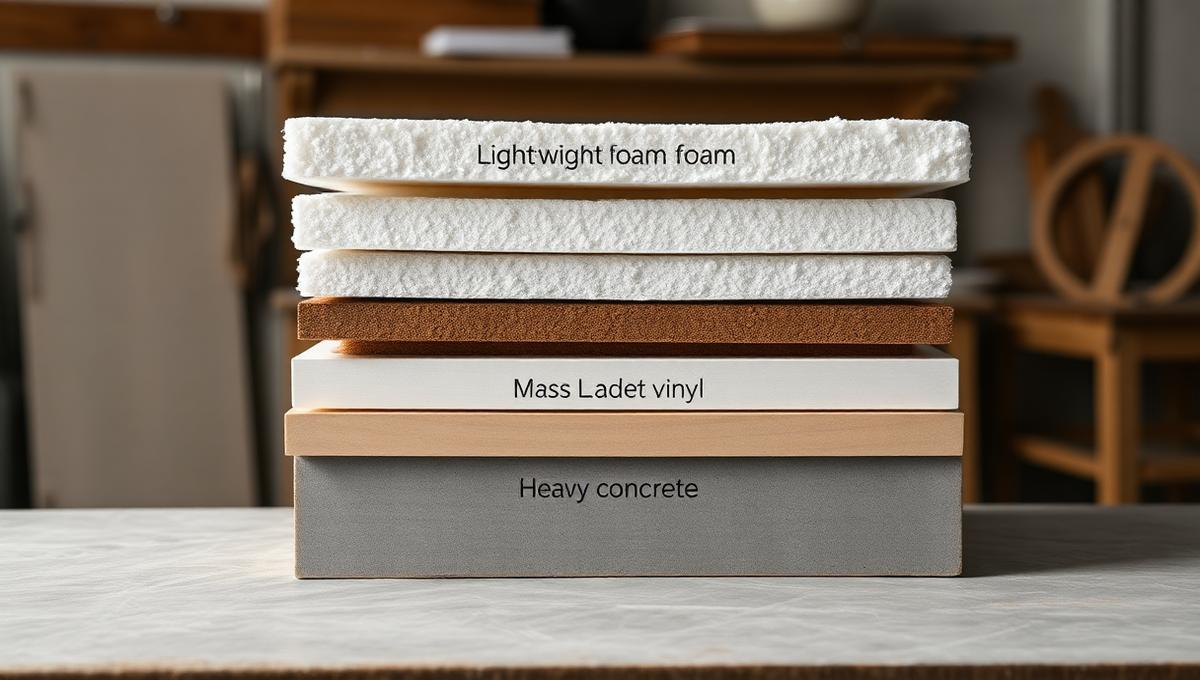
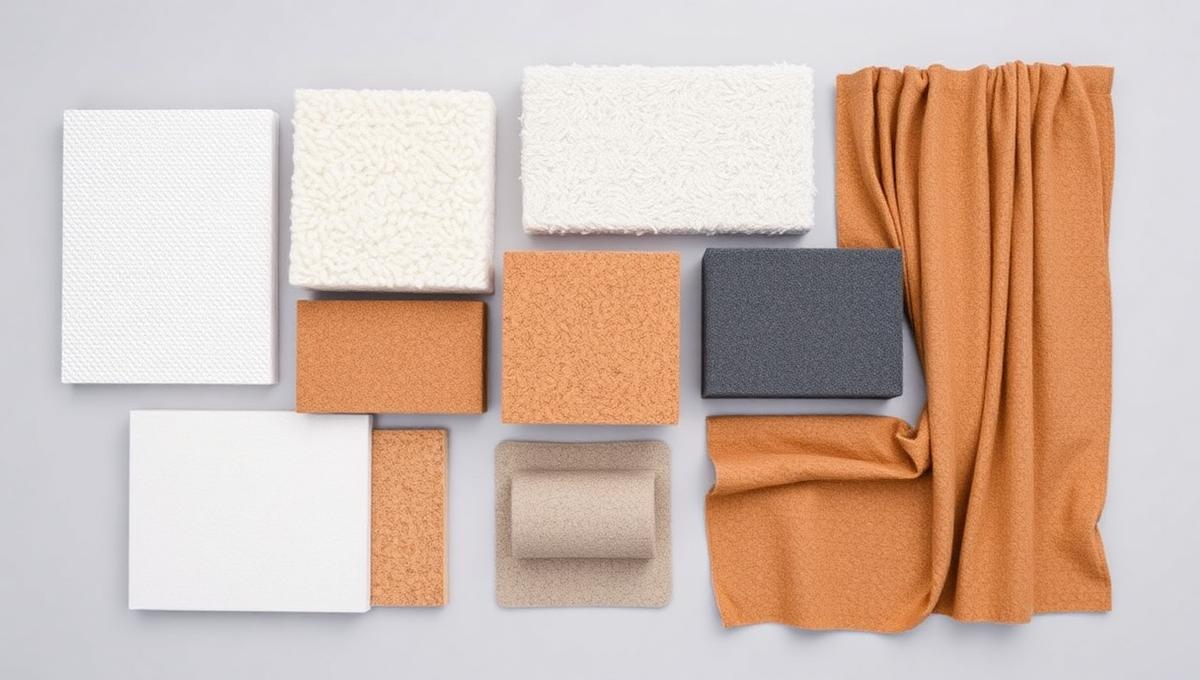
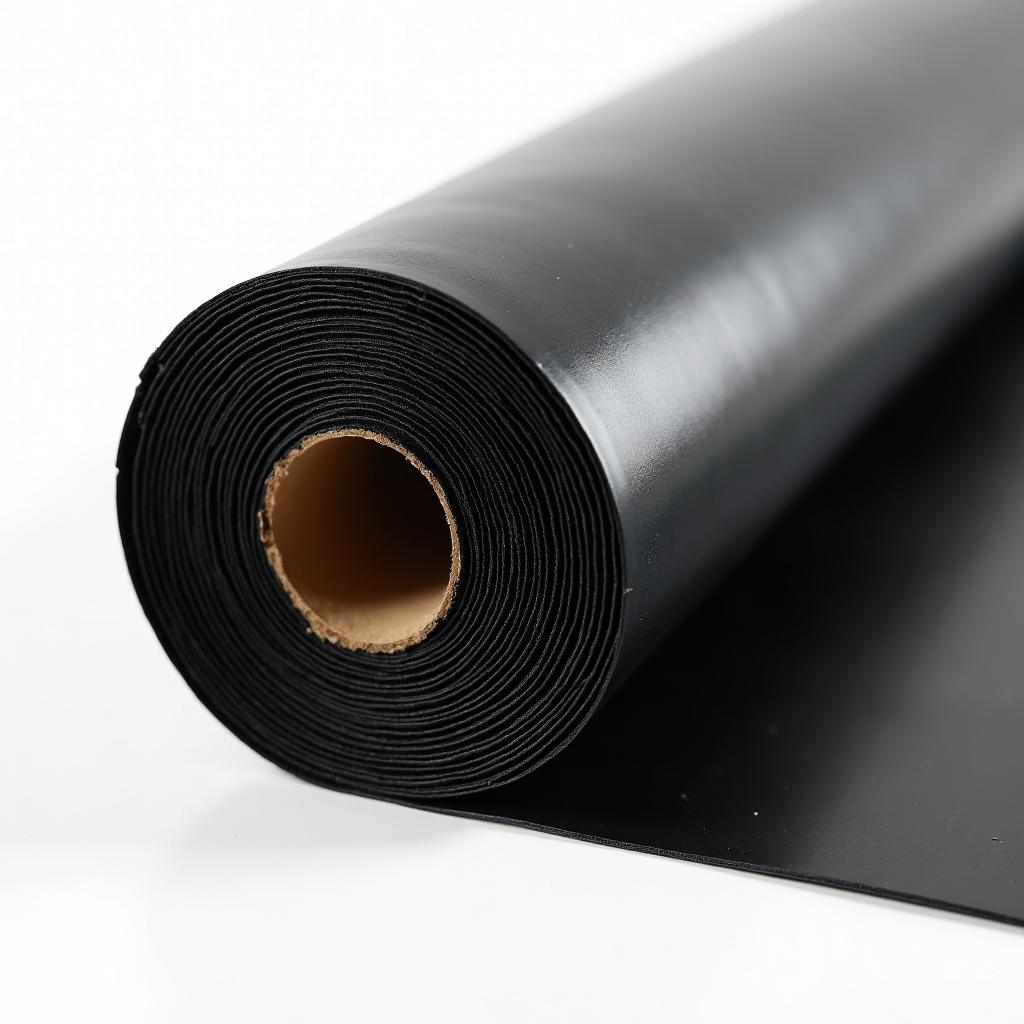
    Cross-section view of stacked soundproofing materials arranged by density from lightweight foam on top to heavy concrete on bottom, showing texture and thickness differences
    Cross-section view of stacked soundproofing materials arranged by density from lightweight foam on top to heavy concrete on bottom, showing texture and thickness differences

    1The Mass Law: Soundproofing's Governing Principle

    The Mass Law states that the sound transmission loss of a single-layer barrier is primarily determined by its surface density (mass per unit area) and the frequency of the sound. In practical terms: heavier walls block more noise. Double the mass per square foot and you gain approximately 6 dB of transmission loss — which is clearly perceptible to the human ear.
    The formula is straightforward: TL = 20 log₁₀(m × f) − 47 dB, where TL is transmission loss in decibels, m is surface density in kg/m², and f is frequency in Hz. You do not need to memorize this equation. You need to understand its implication: mass is the single largest variable you can control.
    This is why a poured concrete wall (approximately 30 lbs/sq ft at 6 inches thick) achieves STC 55+ while a single layer of 1/2-inch drywall (approximately 2 lbs/sq ft) only reaches STC 25-28. The concrete has 15 times more mass per square foot, and the Mass Law rewards that density with dramatically higher sound blocking.
    Every other soundproofing strategy — decoupling, damping, absorption — works in addition to mass. None of them replace it. You cannot decouple your way out of a wall that has insufficient density. Mass is the foundation; everything else is optimization.

    2Density vs. Thickness: They Are Not the Same Thing

    This is where most people get confused. A 4-inch thick piece of acoustic foam weighs about 0.25 lbs per square foot. A 1/8-inch thick sheet of mass loaded vinyl weighs 1.0 lb per square foot. The MLV is 32 times thinner but 4 times heavier. That is the difference between density and thickness.
    Density measures how much mass is concentrated in a given volume — typically expressed as pounds per cubic foot (lbs/ft³) or kilograms per cubic meter (kg/m³). Thickness measures physical dimension only. A material can be extremely thick and still have almost no soundproofing value if its density is low.
    This distinction matters because space is valuable. In residential and commercial construction, every inch of wall thickness costs floor space, reduces room dimensions, and complicates framing details. Dense materials like MLV, lead sheet, and loaded vinyl composites deliver high mass in minimal thickness — a critical advantage in retrofit projects where adding 4 inches of material to every wall is not feasible.
    Think of it this way: a down pillow and a brick can be the same size, but nobody would confuse their ability to block sound. Density is the difference.

    3Density Comparison Table

    The following table compares common building and soundproofing materials by density and the surface density they contribute at typical installation thicknesses:
    MaterialDensity (lbs/ft³)Typical ThicknessSurface Density (lbs/ft²)STC Contribution
    Concrete1446"72.0STC 55+
    Lead Sheet7101/16"3.7STC 28-30
    Mass Loaded Vinyl (1 lb)961/8"1.0STC 26-28
    Gypsum Drywall (5/8")505/8"2.6STC 25-28
    Plywood343/4"2.1STC 22-25
    Mineral Wool (Rockwool)83.5"2.3Absorption only
    Fiberglass Batts1.53.5"0.44Absorption only
    Acoustic Foam1.82"0.30None (absorption only)
    The pattern is unmistakable: materials with higher density per volume deliver higher surface density at thinner profiles, which translates directly into higher STC ratings. Acoustic foam has less than 2 lbs/ft³ density — it is physically incapable of blocking sound regardless of thickness.

    4Why Lightweight Materials Fail at Soundproofing

    When a sound wave hits a barrier, it causes the barrier to vibrate. If the barrier is light, it vibrates easily — transmitting the sound energy to the other side with minimal resistance. This is why you can hear a conversation through a hollow-core interior door (surface density: ~1 lb/sq ft) but not through an exterior solid-core door (surface density: ~4 lbs/sq ft).
    Lightweight materials like acoustic foam, egg cartons, carpet, and thin fabric absorb some sound energy inside their porous structure — reducing echo within the room — but they present almost zero resistance to sound transmission. The sound wave passes through them like wind through a screen door.
    This explains the most common soundproofing failure: someone covers their walls in foam panels, notices less echo when they clap, and assumes they have soundproofed the room. They have not. They have changed the room's internal acoustics while doing nothing to prevent sound from reaching the next room. The foam's density is too low to resist vibration from sound pressure.

    5Why Dense Materials Succeed

    Dense materials resist vibration because their inertia is high. It takes more energy to move a heavy object than a light one — this is basic Newtonian physics. When a sound wave hits a dense barrier, most of the wave's energy is reflected back or converted to heat through internal friction. Only a small fraction passes through.
    Concrete, steel, lead, and mass loaded vinyl all share this characteristic: they pack a lot of mass into a compact volume. The result is high impedance mismatch — the large difference between the air's acoustic impedance and the barrier's impedance causes most sound energy to bounce off rather than transmit through.
    This is also why doubling the thickness of a dense material yields better results than doubling the thickness of a light material. Adding another layer of 5/8-inch drywall (2.6 lbs/sq ft) to a wall gains 5 STC points. Adding another 2 inches of foam (0.30 lbs/sq ft) gains zero STC points. The Mass Law does not care about thickness — it cares about mass per unit area.

    6The Limp Mass Advantage

    Not all dense materials perform equally. Rigid dense materials like concrete, brick, and plywood have a weakness: they have a coincidence frequency — a specific frequency at which the material's bending wave speed matches the speed of sound in air. At this frequency, the material vibrates in sync with the sound wave and transmission loss drops sharply, sometimes by 10-15 dB.
    Limp mass materials like mass loaded vinyl avoid this problem because they have no structural rigidity. They cannot support bending waves. When a sound wave hits MLV, the material flexes rather than resonating — providing consistent transmission loss across all frequencies without the coincidence dip that plagues rigid panels.
    This is why 1/8-inch MLV at 1 lb/sq ft often outperforms 3/4-inch plywood at 2.1 lbs/sq ft in real-world applications — despite the plywood having twice the surface density. The plywood has a coincidence dip around 2,500 Hz (right in the speech frequency range) that creates a weak point. MLV has no such vulnerability.
    The practical takeaway: when choosing between two materials of similar weight, the more flexible (limper) option will typically provide more consistent sound blocking. This is the core engineering principle behind mass loaded vinyl's effectiveness.

    7Density in Real Wall Assemblies

    Understanding density transforms how you evaluate wall designs. Consider three wall assemblies built with the same stud frame:
    Assembly A — Standard wall: Single layer 1/2" drywall each side. Total surface density: ~4 lbs/sq ft. STC: 33.
    Assembly B — Double drywall: Double layer 5/8" drywall each side. Total surface density: ~10.4 lbs/sq ft. STC: 40-43.
    Assembly C — Drywall + MLV: Single layer 5/8" drywall + 1 lb MLV each side. Total surface density: ~7.2 lbs/sq ft. STC: 43-47.
    Assembly C achieves a higher STC than Assembly B despite having less total mass. Why? Because MLV's limp mass characteristic and the layered construction (rigid + limp + rigid) create more effective impedance changes than simply stacking rigid layers. Density sets the floor — but how that density is distributed and what form it takes determines the ceiling.
    The lesson: maximize density first, then optimize how that density is deployed. A wall with mineral wool in the cavity (absorption), MLV on the studs (limp mass barrier), and drywall on the face (rigid mass + finish surface) leverages density at every layer for maximum performance.

    8When Density Alone Is Not Enough

    The Mass Law has limits. Doubling mass adds ~6 dB, but achieving very high STC ratings through mass alone requires impractical amounts of material. Going from STC 50 to STC 60 through mass alone would require roughly 10x the wall weight — turning a standard partition into a concrete bunker.
    This is where the other three soundproofing strategies complement density:
    Decoupling: Breaking the physical connection between wall surfaces (resilient channels, sound clips) prevents vibration from transferring across the assembly — adding 5-12 STC points without adding mass.
    Damping: Viscoelastic compounds (Green Glue) convert vibrational energy into heat within the assembly — adding 5-9 STC points.
    Absorption: Porous materials in the cavity (mineral wool, fiberglass) absorb airborne sound energy bouncing between surfaces — adding 4-8 STC points.
    The highest-performing wall assemblies combine all four strategies: dense barriers (MLV + drywall) + decoupling (resilient channels) + damping (Green Glue) + absorption (mineral wool). This approach routinely achieves STC 55-65 in standard wood-frame construction — performance that mass alone could only achieve with 12+ inches of concrete.
    But make no mistake: density remains the foundation. Without adequate mass in the assembly, decoupling, damping, and absorption have diminished returns. Build on density first, then add the refinements.

    10Conclusion

    Material density is not just one factor in soundproofing — it is the most important factor. The Mass Law dictates that heavier barriers block more sound, and no amount of foam, carpet, or lightweight treatment can compensate for insufficient mass. Dense materials like mass loaded vinyl, concrete, and layered drywall form the foundation of every effective soundproofing assembly. Limp mass materials like MLV take density a step further by eliminating the resonance weaknesses of rigid panels. Understand density, and you will never waste money on lightweight materials that physics guarantees cannot work.

    FAQs: Material Density Soundproofing

    Need Expert Soundproofing Advice?

    Our team of soundproofing specialists is here to help you choose the right products and installation methods for your museum or gallery project.