Acoustics10 min readAuthorMass Loaded Vinyl DirectPublishedUpdated

    The Loudest Sound Ever Recorded: A Complete History of Earth's Most Extreme Acoustic Events
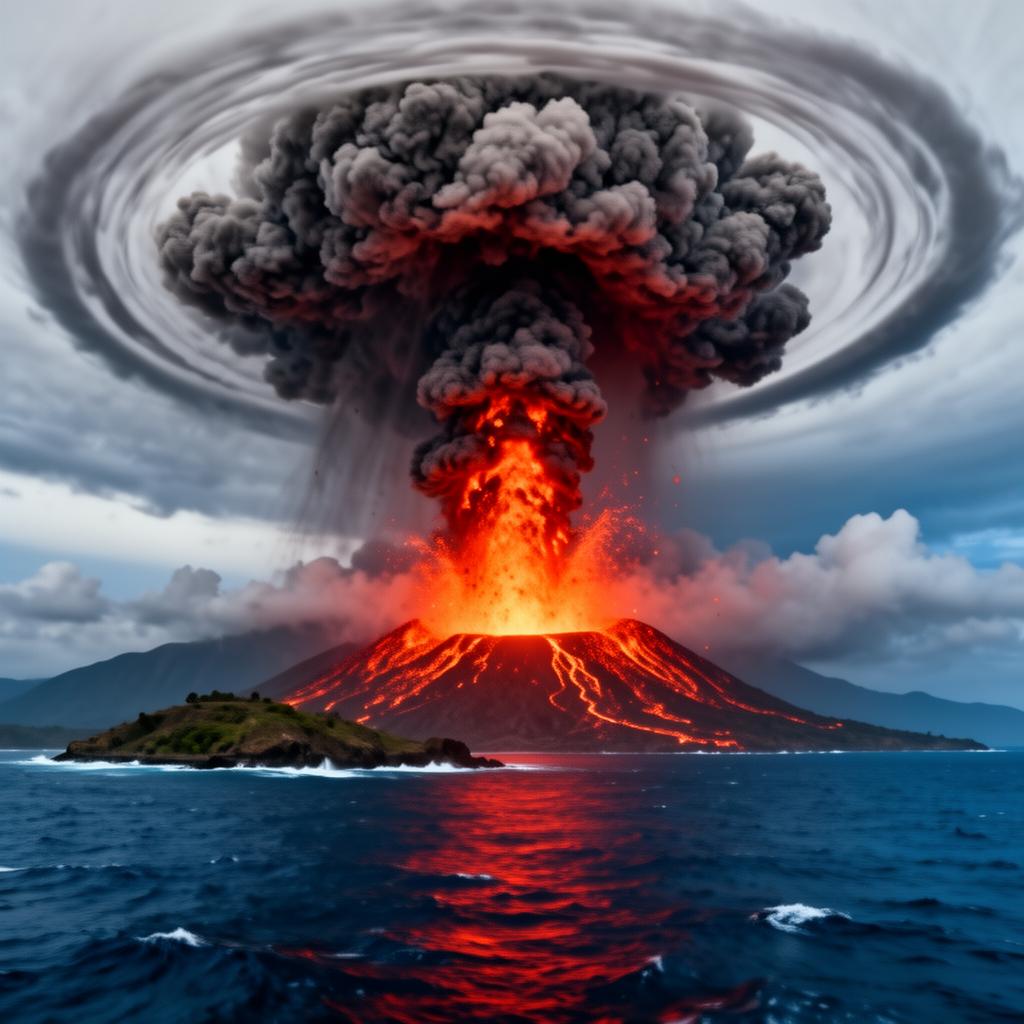
    Dramatic volcanic eruption with massive ash cloud and visible shockwave over the ocean, representing the loudest sound ever recorded in human history
    Dramatic volcanic eruption with massive ash cloud and visible shockwave over the ocean, representing the loudest sound ever recorded in human history

    1What Qualifies as the Loudest Sound?

    Before ranking, it is important to understand what "loudest" actually means in physics. Sound is a pressure wave traveling through a medium — usually air. We measure its intensity in decibels (dB), a logarithmic scale where every 10 dB increase represents a tenfold increase in sound energy.
    For context, here is what common decibel levels feel like:
    0 dB: Threshold of human hearing — the faintest detectable sound
    60 dB: Normal conversation
    85 dB: Sustained exposure causes hearing damage
    120 dB: Pain threshold — a jet engine at 25 meters
    140 dB: Immediate hearing damage — standing near a gunshot
    194 dB: Theoretical maximum for sound in Earth's atmosphere (more on this later)
    The challenge with historical "loudest sounds" is that modern digital recording equipment only became available in recent decades. Events like Krakatoa and Tunguska were measured through barometric pressure readings, seismographs, and eyewitness accounts rather than calibrated microphones. The 2022 Tonga eruption changed everything — it was the first truly extreme acoustic event captured by a global network of modern sensors.

    2#1: Krakatoa Eruption (1883) — ~310 dB

    The eruption of Krakatoa on August 27, 1883, remains the undisputed loudest sound in recorded history. The volcanic island, located in the Sunda Strait between Java and Sumatra, exploded with an estimated energy output equivalent to 200 megatons of TNT — roughly four times the yield of the Tsar Bomba, the most powerful nuclear weapon ever detonated.
    The sound facts are almost incomprehensible:
    Estimated volume at source: ~310 dB SPL, according to the American Academy of Audiology
    Audible distance: Heard clearly on Rodrigues Island, 4,800 km (3,000 miles) away — equivalent to hearing a sound in New York City that originated in Dublin, Ireland
    Eardrums ruptured: Crew members on the British ship Norham Castle, 64 km from the eruption, reported the sound as devastating
    Pressure waves: Barographs around the world recorded the atmospheric shockwave circling the globe 3.5 times over the following five days
    Surface coverage: Guinness World Records confirms the sound was heard across approximately 8% of the Earth's surface
    The eruption destroyed two-thirds of the island, generated tsunamis up to 30 meters high that killed over 36,000 people, and ejected so much ash into the stratosphere that global temperatures dropped by 1.2°C the following year. Vivid red sunsets were visible worldwide for months — believed to have inspired the fiery sky in Edvard Munch's painting The Scream.
    To put 310 dB in perspective: this is not simply "very loud." Because decibels are logarithmic, 310 dB represents a pressure wave trillions of times more intense than the 194 dB theoretical limit of sound in air. At this level, the "sound" has transitioned into a shock wave — a discontinuous pressure front that moves faster than the speed of sound and behaves more like an explosion than a noise.

    3#2: Tsar Bomba (1961) — ~224 dB

    On October 30, 1961, the Soviet Union detonated the AN602 hydrogen bomb — known as Tsar Bomba — over Novaya Zemlya in the Arctic Ocean. With a yield of 50 megatons of TNT, it remains the most powerful nuclear weapon ever detonated and produced the loudest man-made sound in history.
    Key acoustic data:
    Estimated volume: ~224 dB at the detonation point
    Shockwave reach: The pressure wave circled the Earth three times, detected by barometric sensors worldwide
    Destruction radius: Complete destruction within a 35 km radius; third-degree burns possible at 100 km
    Windows shattered: Reports of broken windows in Finland and Norway, over 900 km away
    Mushroom cloud: Rose 67 km into the atmosphere — seven times the height of Mount Everest
    The Tsar Bomba was intentionally designed at half its theoretical maximum yield (100 megatons) because Soviet scientists feared the full-power version might ignite the atmosphere. Even at half power, the seismic shock from the detonation registered as a 5.0 magnitude earthquake, and the flash was visible 1,000 km away.

    4#3: Hunga Tonga Eruption (2022) — Loudest Digitally Recorded

    On January 15, 2022, the underwater volcano Hunga Tonga–Hunga Ha'apai erupted in the South Pacific with a force that researchers now consider the loudest sound captured by modern digital instruments. Unlike Krakatoa and Tsar Bomba, this event was recorded by a global network of infrasound sensors, weather stations, and satellite systems in real time.
    Key findings:
    Sound pressure: Infrasound stations thousands of kilometers away recorded pressure waves exceeding normal atmospheric events by orders of magnitude
    Global reach: The pressure wave was detected by barometers on every continent, circling the Earth at least four times
    Satellite confirmation: Weather satellites captured the visible shockwave expanding outward from the eruption point at near the speed of sound
    Audible distance: Residents in Alaska, over 9,000 km away, reported hearing a distinct boom
    Tsunami generation: The eruption triggered tsunamis across the Pacific, reaching the coasts of Japan, the United States, and South America
    Acoustic researcher Milton Garces of the University of Hawaii described the Hunga Tonga eruption as generating the most powerful sound-like wave ever recorded in the modern era. The distinction matters: while Krakatoa's estimated decibel level was higher, the Tonga event is the first extreme acoustic event where we have precise, calibrated digital measurements from multiple global sensor networks.

    5#4: Tunguska Event (1908) — Heard 1,000 km Away

    On June 30, 1908, a massive explosion flattened approximately 80 million trees across 2,150 square kilometers of remote Siberian forest near the Tunguska River. The cause is believed to have been the airburst of a meteoroid or comet fragment at an altitude of 5-10 kilometers above the surface.
    Acoustic impact:
    Energy release: Estimated at 10-15 megatons of TNT — roughly 1,000 times the Hiroshima bomb
    Audible range: The explosion was heard over 1,000 km away, with witnesses describing a deafening boom followed by a sustained roar
    Seismic detection: Seismographic stations across Europe registered the event; atmospheric pressure changes were detected as far away as the United Kingdom
    Physical effects: The blast wave knocked people off their feet, shattered windows, and created a thermal pulse that scorched trees at the epicenter
    Because the Tunguska Event occurred in one of the most remote regions on Earth, there were no nearby instruments to measure the sound directly. Had it occurred over a city, it would have caused catastrophic destruction. Scientists estimate a Tunguska-scale impact occurs roughly once every 300-1,000 years.

    6#5: Saturn V Rocket Launch — 204 dB

    The Saturn V rocket that carried Apollo astronauts to the Moon produced the loudest sustained man-made sound in a controlled setting. At liftoff, the five F-1 engines generated 7.6 million pounds of thrust, producing sound levels measured at 204 dB at the launch pad.
    Acoustic effects:
    Flame trench: NASA designed massive flame deflection trenches and flooded them with 300,000 gallons of water per minute to suppress the acoustic energy
    Structural damage: Despite being 5.6 km from the launch pad, the CBS News broadcast building had ceiling tiles shaken loose during the Apollo 11 launch
    Ground vibration: The sound was felt as physical vibration by spectators at the viewing stands, 5.6 km away
    Comparison: Modern rockets like SpaceX's Falcon Heavy produce approximately 150-160 dB at comparable distances — significantly quieter due to improved engine design
    NASA later developed the Sound Suppression System — a massive water deluge system — specifically because early launches demonstrated that acoustic energy alone could damage the spacecraft and launch structure. This system is still used today for Space Launch System (SLS) launches.

    7The Complete Decibel Comparison Table

    EventEst. dBYearAudible Distance
    Krakatoa Eruption~310 dB18834,800 km (3,000 mi)
    Tsar Bomba~224 dB1961~1,000 km (620 mi)
    Hunga Tonga EruptionTBD*20229,000+ km (5,600 mi)
    Tunguska Event~300 dB†19081,000+ km (620 mi)
    Saturn V Rocket204 dB1969~80 km (50 mi)
    Jet Engine (takeoff)140 dB~2 km
    Pain Threshold120 dB
    *Hunga Tonga's precise dB at source is still under scientific review; it is confirmed as the loudest event ever captured by modern digital instruments. †Tunguska estimates vary widely due to the lack of nearby instruments.

    8Why Sound Cannot Exceed ~194 dB in Air

    This is one of the most fascinating facts in acoustics: there is a physical upper limit to how loud a sound wave can be in Earth's atmosphere, and that limit is approximately 194 dB.
    Sound is a pressure oscillation — a wave of compression and rarefaction (expansion) moving through air. At sea level, atmospheric pressure is approximately 101,325 Pascals. A sound wave works by momentarily increasing pressure (compression) and then decreasing it (rarefaction). The maximum rarefaction possible is a perfect vacuum — 0 Pascals. This means the maximum pressure swing is limited to one full atmosphere of variation.
    That maximum swing — from normal atmospheric pressure to a perfect vacuum — corresponds to exactly 194 dB SPL. Beyond this point, the "sound" is no longer a traditional acoustic wave. It becomes a shock wave — a non-linear pressure discontinuity that behaves fundamentally differently from sound. This is why events like Krakatoa (estimated at 310 dB) are described as shock waves rather than sounds in the traditional sense. The 310 dB figure represents the total energy released, expressed in decibel terms, but the physical phenomenon is beyond what we normally classify as "sound."
    This also explains why soundproofing matters even for non-extreme scenarios. When a neighbor's subwoofer produces 90 dB through your shared wall, mass loaded vinyl reduces that transmission by 15-25 dB — bringing it below the threshold where it disrupts sleep, conversation, or concentration. You do not need to block Krakatoa-level energy; you need to control everyday acoustic intrusions effectively.

    10Conclusion

    The loudest sound in recorded history remains the 1883 eruption of Krakatoa — an event so powerful it was heard across 8% of the Earth's surface and sent pressure waves circling the globe nearly four times. The Tsar Bomba, Hunga Tonga eruption, Tunguska Event, and Saturn V rocket launch round out the top five, each demonstrating the extraordinary forces that nature and human engineering can unleash. Understanding extreme acoustics is not just fascinating trivia — it illuminates the fundamental physics of how sound, pressure, and energy interact. And whether you are blocking volcanic shockwaves or just your upstairs neighbor's footsteps, the science of controlling sound starts with understanding its power.

    FAQs: Loudest Sound Ever Recorded

    Need Expert Soundproofing Advice?

    Our team of soundproofing specialists is here to help you choose the right products and installation methods for your museum or gallery project.