How Ancient Greeks Designed Perfect Amphitheaters Without Modern Technology
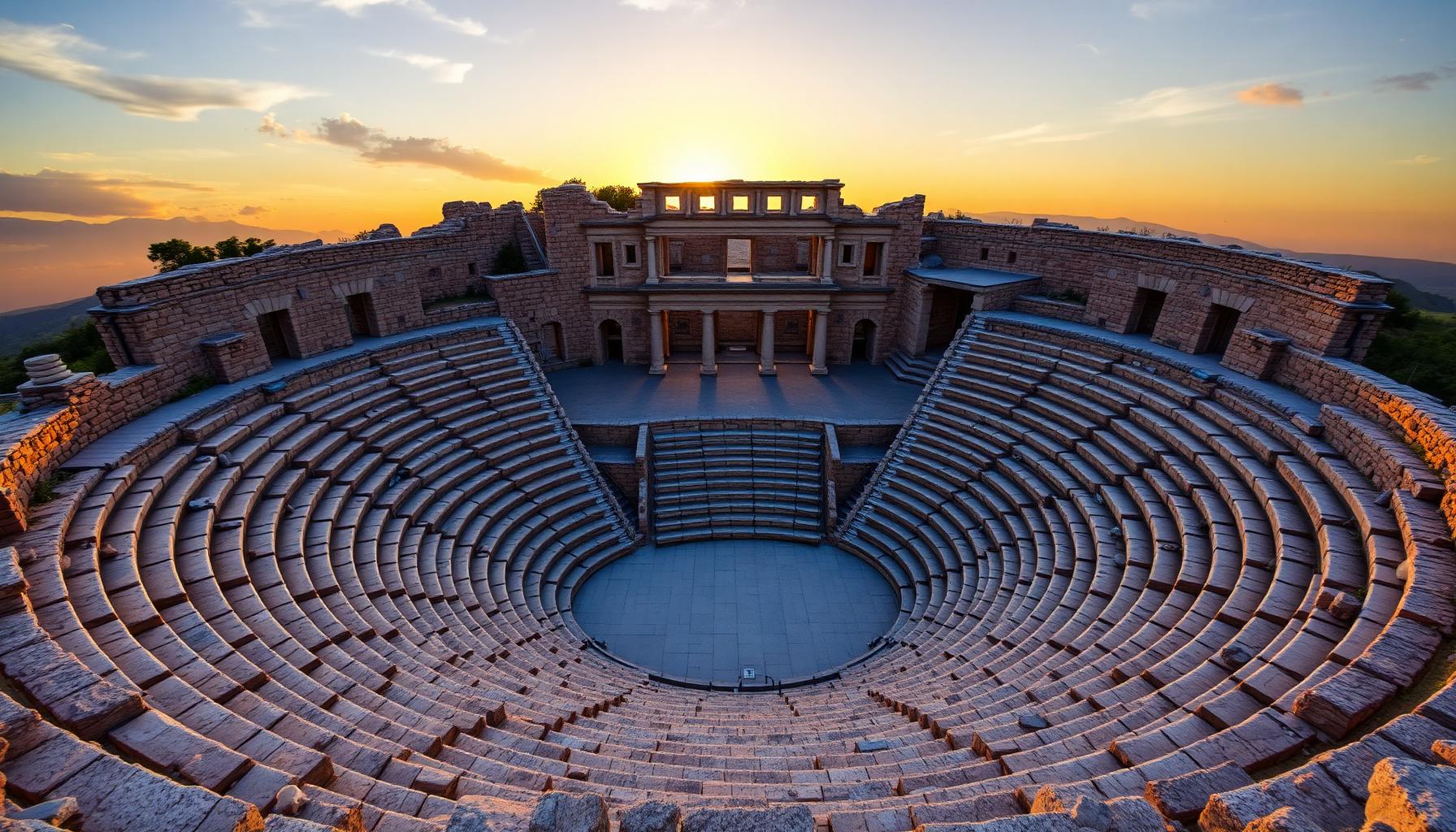
1The Acoustic Marvel of Epidaurus
Exceptional Speech Intelligibility
• Background noise suppression: The theater naturally filters out low-frequency environmental noise below 500 Hz
• Speech frequency amplification: Human voice frequencies (500-2000 Hz) experience up to 5 dB boost through natural acoustic filtering
• Minimal reverberation: Open-air design eliminates sound reflections that muddy indoor spaces
• 14,000-seat capacity: Every seat, even those in the furthest rows, maintains clear acoustic connection to performers
The Match Drop Test
• Coin drop clarity: Dropping a coin on the stage produces a distinct metallic sound reaching the back rows
• Paper tear demonstration: Tearing paper slowly reveals texture details audible 55+ meters away
• Whisper projection: Performers can whisper lines that remain intelligible to distant audience members
• No amplification needed: Modern performances at Epidaurus use no electronic sound reinforcement
Preservation Through Millennia
• Minimal reconstruction: Unlike many ancient sites, Epidaurus retains original acoustic geometry
• Active performance venue: Annual Athens Epidaurus Festival brings modern audiences to experience ancient acoustics
• UNESCO World Heritage: Protected status ensures preservation for future acoustic research
• Ongoing studies: Researchers continue to discover new acoustic principles in the structure
2Geometry and the Golden Ratio
Semicircular Seating Design
• 26-degree slope: Each row rises at a carefully calibrated angle maximizing sight lines and sound paths
• 0.75-meter row spacing: Consistent vertical spacing between rows creates uniform acoustic intervals
• Central focus point: The orchestra center serves as the acoustic focal point for the entire seating area
• Bilateral symmetry: Perfectly mirrored left and right sections prevent acoustic imbalances
The Orchestra Circle
• Polished limestone floor: Hard reflective surface launches sound waves upward into the seating
• Raised center stone: A circular altar stone at the exact center marks the optimal performance position
• Boundary reflection: Sound waves reflect off the semicircular seating back toward the stage
• Standing wave formation: The circular geometry creates constructive interference patterns
Mathematical Precision
• Pythagorean harmonics: Row spacing and angles may relate to musical interval ratios
• Modular design: The structure uses a consistent measurement unit throughout construction
• Geometric progression: Seating capacity increases in a regular mathematical pattern
• Proportion to human scale: All dimensions relate to comfortable human seating and sightlines
3Limestone as a Natural Sound Filter
Material Acoustic Properties
• Density (2.3-2.7 g/cm³): High mass prevents transmission of low-frequency vibrations while reflecting mid-range frequencies
• Porosity variation: Different limestone layers have varying porosity levels affecting frequency-specific absorption
• Surface texture: Weathered limestone develops micro-textures that diffuse high-frequency reflections
• Thermal properties: Stone temperature affects sound speed and creates subtle acoustic focusing effects
The Seat Filter Discovery
• Speech band enhancement: Frequencies between 500-2000 Hz (human voice range) reflect efficiently
• Periodic grating effect: Regular spacing of seat rows creates an acoustic filter similar to optical diffraction gratings
• 5 dB amplification: Voice frequencies experience measurable amplification compared to background noise
• Unintended consequence: Ancient builders likely discovered this through trial and error, not theoretical knowledge
Comparison to Other Materials
• Marble too reflective: Smoother marble would create harsh echoes and flutter
• Concrete different density: Roman concrete amphitheaters have notably different acoustic character
• Clay brick too porous: Terracotta would absorb mid-range frequencies needed for speech
• Local limestone perfect: The specific limestone quarried near Epidaurus happened to have ideal properties
4The Role of Wind and Atmospheric Conditions
Wind Management
• Southern orientation: Stage faces south, placing audience backs to northern weather
• Natural wind break: Rising seating tiers create a barrier that deflects wind above audience heads
• Seasonal performance: Ancient festivals occurred during calm summer months
• Microclimate effects: The bowl shape creates a microclimate different from surrounding areas
Temperature and Humidity
• Summer performances: Warm evening air creates slight upward sound bending toward audience
• Humidity effects: Mediterranean summer air humidity levels minimize high-frequency absorption
• Temperature inversions: Evening cooling can create acoustic ducts that enhance sound transmission
• Altitude (340m): Elevation affects air density and sound propagation characteristics
Time-of-Day Acoustics
• Reduced background noise: Evening hours have less wind and fewer daytime environmental sounds
• Cooler temperatures: Evening cooling improves acoustic clarity
• Natural lighting: Sunset timing coordinated with dramatic moments in performances
• Audience stillness: Cooler evening temperatures meant less audience fidgeting noise
5Modern Science Explains the Mystery
Computer Acoustic Modeling
• Frequency response mapping: Digital models show how different frequencies behave throughout the space
• Impulse response measurement: Researchers measure exact time delays between direct and reflected sound
• 3D acoustic visualization: Advanced software creates visual maps of sound pressure levels
• Comparison to modern halls: Epidaurus compares favorably to purpose-built 20th-century concert halls
The Ultrasonic Theory
• Psychoacoustic effects: The theater may exploit human hearing perception in ways we don't fully understand
• Binaural advantages: The geometry may enhance spatial hearing cues
• Masking reduction: Background noise filtering may reduce psychoacoustic masking effects
• Debate continues: Acoustic researchers still disagree on which mechanisms are most important
Lessons for Modern Design
• Geometric optimization: Simple mathematical relationships can create complex acoustic benefits
• Site-specific design: Working with environmental conditions rather than fighting them
• Unintended discoveries: Experimentation can reveal properties that theory doesn't predict
• Less can be more: Simple open-air design sometimes outperforms complex enclosed spaces
6Other Notable Greek Amphitheaters
The Theater of Delphi
• 1,800m altitude: High elevation creates unique atmospheric effects
• Steep hillside: 35-degree slope provides clear acoustic paths
• Panoramic backdrop: Valley views below don't interfere with acoustics
• Religious context: Built near Apollo's temple, hosting Pythian Games performances
The Theater of Dodona
• Three-level design: Unusual triple-tier seating arrangement
• Oracle sanctuary: Associated with Zeus oracle site
• Later construction: Built in 3rd century BCE, after Epidaurus
• Size vs. quality: Demonstrates the acoustic challenges of scaling up design
The Odeon of Herodes Atticus
• Stone roof structure: Originally covered, changing acoustic character
• Modern use: Hosts Athens Epidaurus Festival performances
• Urban location: City background noise requires different acoustic approach
• Roman elements: Incorporates Roman architectural features affecting acoustics
The Theater of Argos
• Modified in Roman era: Later changes altered original Greek acoustics
• Less preserved: Damage makes it harder to assess original acoustic design
• Similar limestone: Same local stone as Epidaurus
• Comparison studies: Researchers compare it to Epidaurus to understand design variation
8Conclusion
FAQs: Ancient Greek Amphitheater Acoustics
Related Guides in Acoustics
Continue exploring with these hand-picked articles
Loudest College Football Stadiums in 2026: All 20 Power Conference Venues Ranked
The loudest college football stadiums in 2026, ranked by decibel records, capacity, acoustics and crowd intensity. Compare all 20 Power Conference venues with verified noise data and conference-by-conference breakdowns.
Loudest NBA Arenas Ranked: All 30 NBA Home Arenas
Complete ranking of all 30 NBA arenas by loudness. Covers crowd reputation, arena design, playoff atmosphere, home-court history, and documented noise moments across every current NBA venue.
Loudest NFL Stadiums This Season: All 30 Ranked for 2026
Who has the loudest NFL stadium this season? Our 2026 ranking covers all 30 NFL stadiums by decibel records, fan culture, roof design, and crowd density — with the documented noise moments behind every ranking.
Our Complete Product Line
Professional-grade soundproofing materials for any application






Need Expert Soundproofing Advice?
Our team of soundproofing specialists is here to help you choose the right products and installation methods for your museum or gallery project.