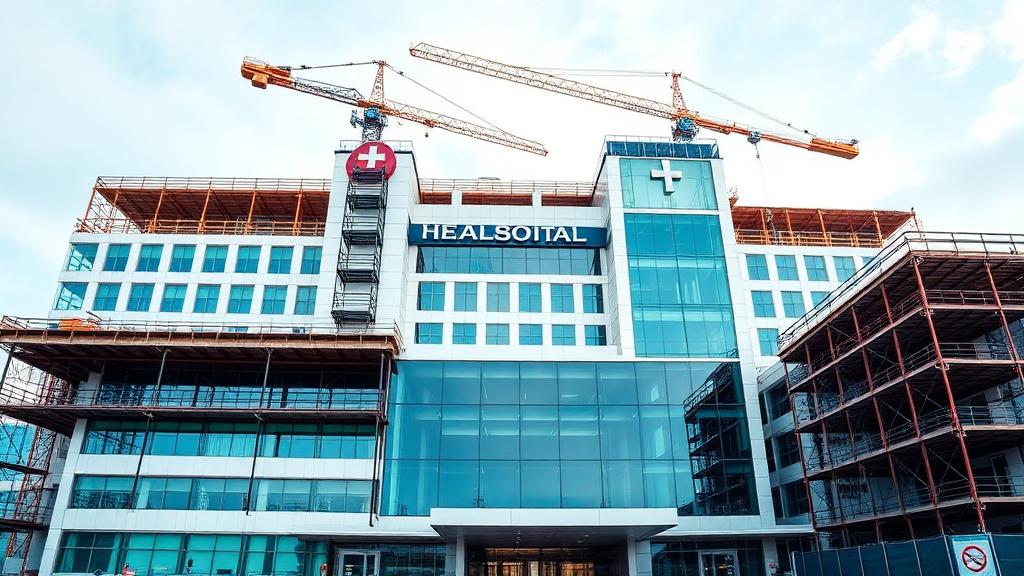
Hospital Construction: MLV Requirements & Building Codes
1Why Hospital Acoustics Matter More Than Any Other Building Type
The Clinical Case for Hospital Soundproofing
• Cardiovascular stress: Noise exposure above 55 dB increases heart rate, blood pressure, and stress hormone levels in patients
• Medication errors: Staff working in high-noise environments make 12% more medication errors due to communication difficulties
• Patient falls: Sleep-deprived patients from nighttime noise exposure have higher fall rates
• Readmission rates: Hospitals with poor acoustics show measurably higher 30-day readmission rates
The Regulatory and Financial Stakes
• HCAHPS scores: Hospital noise levels directly affect patient satisfaction surveys that impact Medicare reimbursement rates
• Joint Commission surveys: Acoustic deficiencies can affect accreditation status
• Staff turnover: High-noise environments increase nursing turnover by 25%, with replacement costs of $40,000-$60,000 per nurse
• Legal liability: Patients have successfully sued hospitals for noise-related sleep deprivation and HIPAA privacy breaches
2What Building Codes Require for Healthcare Facilities
FGI Guidelines for Design and Construction of Hospitals
• STC 50 (field) for patient room to corridor walls
• STC 55 (field) for patient room to diagnostic/treatment areas
• STC 60 (field) for operating rooms and procedure rooms
• STC 60 (field) for psychiatric patient rooms
• Specific background noise criteria (RC or NC ratings) for different room types
State Health Department Requirements
• Texas: Additional requirements for psychiatric facilities and emergency departments
• New York: Enhanced requirements for urban hospitals and those near transit
• Florida: Hurricane-resistant construction must maintain acoustic performance
| Hospital Space Type | FGI STC Requirement | FGI NC/RC Limit | MLV Recommended |
|---|---|---|---|
| Patient Room to Patient Room | STC 50 (field) | NC 35-40 | 1 lb/sf MLV |
| Patient Room to Corridor | STC 50 (field) | NC 35-40 | 1 lb/sf MLV |
| Operating Room | STC 60 (field) | NC 25-35 | 2 lb/sf MLV |
| MRI Suite | STC 55-60 (field) | NC 30-40 | 2 lb/sf MLV |
| ICU Patient Room | STC 50-55 (field) | NC 30-35 | 1-2 lb/sf MLV |
| Psychiatric Unit | STC 60 (field) | NC 35-40 | 2 lb/sf MLV |
| Emergency Department | STC 50 (field) | NC 40-45 | 1 lb/sf MLV |
3HIPAA & Speech Privacy Requirements
Understanding Speech Privacy Classes
• Normal privacy: Conversations are audible but generally not intelligible (SPI 80-95)
• Marginal privacy: Occasional words may be understood (SPI 65-80)—generally unacceptable for PHI discussions
Where Confidential Privacy is Required
• Consultation rooms: Discussions with family members about patient conditions
• Pharmacy counseling areas: Medication discussions including conditions being treated
• Registration and admitting: Collection of insurance and medical history information
• Medical records areas: Discussions referencing specific patient records
• Nursing stations: Verbal orders and patient status discussions
How MLV Supports HIPAA Compliance
• MLV-enhanced walls: Reach confidential privacy levels (STC 50-60)
• Key frequencies: Speech intelligibility depends on mid-range frequencies (500-4000 Hz) where MLV excels
• Flanking control: MLV's continuous membrane seals gaps that allow speech leakage
4Is MLV Required by Code for Hospitals?
Why MLV Appears in Hospital Specifications
• Space constraints: Hospitals pay $400-$800 per square foot; every inch of wall thickness affects floor area
• Critical room adjacencies: OR suites next to mechanical rooms require STC 60+ that's nearly impossible without MLV
• Retrofit capability: When post-construction testing reveals deficiencies, MLV can be added without demolition
• Consistency: MLV delivers predictable mass regardless of installer workmanship
When MLV Becomes Mandatory in Practice
• MRI suites: Electromagnetic shielding requirements often combine with acoustic needs, making MLV-based assemblies standard
• Psychiatric units: STC 60 requirements for patient safety and privacy virtually require MLV
• Mechanical room adjacencies: Low-frequency HVAC and generator noise requires 2 lb/sf MLV minimum
• Renovation projects: Adding MLV to existing walls avoids costly demolition and reconstruction
5Critical Hospital Areas Requiring MLV
Operating Rooms and Procedure Suites
• Low background noise: NC 25-35 to allow quiet verbal communication during procedures
• Typical assembly: Double-stud walls with 2 lb/sf MLV, double layers of 5/8" drywall both sides
• Critical detail: All penetrations (medical gases, data, electrical) require acoustic treatment
Diagnostic Imaging (MRI, CT, PET)
• RF shielding: Copper mesh or sheet often combined with MLV for acoustic control
• Patient comfort: Pre-scan areas must be quiet to reduce patient anxiety
• Typical assembly: 2 lb/sf MLV with RF shielding layer, specialized acoustic doors
Intensive Care Units
• Lower NC targets: NC 30-35 to allow continuous patient monitoring
• Open vs. enclosed: Trend toward private ICU rooms increases demising wall acoustic demands
• Medical equipment noise: Walls must block ventilator and monitor sounds from neighboring rooms
Psychiatric Units
• Ligature resistance: Wall construction must not provide attachment points
• Impact resistance: Walls must withstand patient contact without damage
• MLV approach: MLV installed behind impact-resistant inner layer
Emergency Department
• HIPAA challenges: Open treatment areas require creative acoustic solutions
• Curtain limitations: Fabric curtains provide visual but not acoustic privacy
• MLV applications: Fixed wall separations between treatment bays where possible
6MLV & Fire Code Considerations for Healthcare
Healthcare Fire Rating Requirements
• Corridor walls: 1-hour smoke partitions in most jurisdictions
• Operating rooms: Often 1-2 hour fire separation
• Smoke compartment boundaries: 1-hour fire barriers with self-closing doors
• Mechanical rooms: 2-hour separation from occupied spaces
MLV Fire Performance in Healthcare
• Low smoke development: Critical for patient evacuation scenarios
• UL-listed assemblies: Many fire-rated healthcare wall assemblies include MLV
• Hospital-grade products: Some MLV manufacturers offer healthcare-specific products with enhanced fire documentation
Installation Requirements for Healthcare
• Firestopping: All penetrations must be firestopped per ASTM E814/UL 1479
• Above-ceiling continuity: Walls typically extend to structure, not just to ceiling
• Documentation: Fire test reports and UL listings required for plan review and inspections
• Third-party inspection: Many jurisdictions require special inspection of fire-rated assemblies
7Example Hospital Assemblies Using MLV
Patient Room Demising Wall (STC 50 Field)
• 3" mineral wool insulation in cavity
• 1 lb/sf MLV attached to studs (one side)
• 5/8" Type X drywall both sides
• Acoustic sealant at all perimeters and penetrations
• Result: STC 52-54 field, meets FGI requirements
Operating Room Wall (STC 60 Field)
• Full cavity mineral wool insulation both stud cavities
• 2 lb/sf MLV on one stud frame (OR side)
• 1 lb/sf MLV on opposite stud frame
• Double 5/8" Type X drywall both sides
• All penetrations acoustically treated
• Result: STC 62-65 field, exceeds FGI requirements
MRI Suite Wall (STC 55-60 Field + RF Shielding)
• Full cavity mineral wool insulation
• Copper RF shielding layer
• 2 lb/sf MLV over RF shielding
• Double 5/8" Type X drywall both sides
• RF-shielded door assembly with acoustic seals
• Result: STC 58-62 field with RF isolation
Psychiatric Unit Wall (STC 60 Field, Impact-Resistant)
• Full cavity mineral wool insulation
• 2 lb/sf MLV attached to studs
• 5/8" Type X drywall
• Impact-resistant gypsum or FRP panel (patient side)
• All components meet ligature-resistant requirements
• Result: STC 60-63 field with patient safety features
Floor-Ceiling Assembly (STC 55 / IIC 55 Field)
• Resilient underlayment (3-5mm) over slab
• 1 lb/sf MLV layer
• Floating floor assembly
• Suspended acoustic ceiling below
• Result: STC 56-58, IIC 54-58 field, suitable for patient rooms over occupied spaces
9Conclusion
FAQs: Hospital MLV Building Codes
Related Guides in Building Codes
Continue exploring with these hand-picked articles
Airport Construction: MLV Requirements and Building Codes
Building code requirements for soundproofing in airports and aviation facilities. How MLV helps developers meet FAA acoustic standards, TSA security requirements, and create comfortable passenger environments.
Museum Construction: MLV Requirements and Building Codes
Building code requirements for soundproofing in museums and cultural institutions. How MLV helps developers achieve gallery-to-gallery isolation, protect collections from vibration damage, meet conservation standards, and create contemplative visitor experiences.
Hotel Construction: MLV Requirements & Building Codes
Building code requirements for soundproofing in hotels and hospitality construction. How MLV helps developers meet STC requirements, brand acoustic standards, and cost-effective wall/floor assemblies for hotel projects.
Our Complete Product Line
Professional-grade soundproofing materials for any application
Need Expert Soundproofing Advice?
Our team of soundproofing specialists is here to help you choose the right products and installation methods for your museum or gallery project.