Comparisons7 min readAuthorMass Loaded Vinyl DirectPublishedUpdated

    Flanking Noise vs. Direct Transmission: The Hidden Reason Your Soundproofing Isn't Working
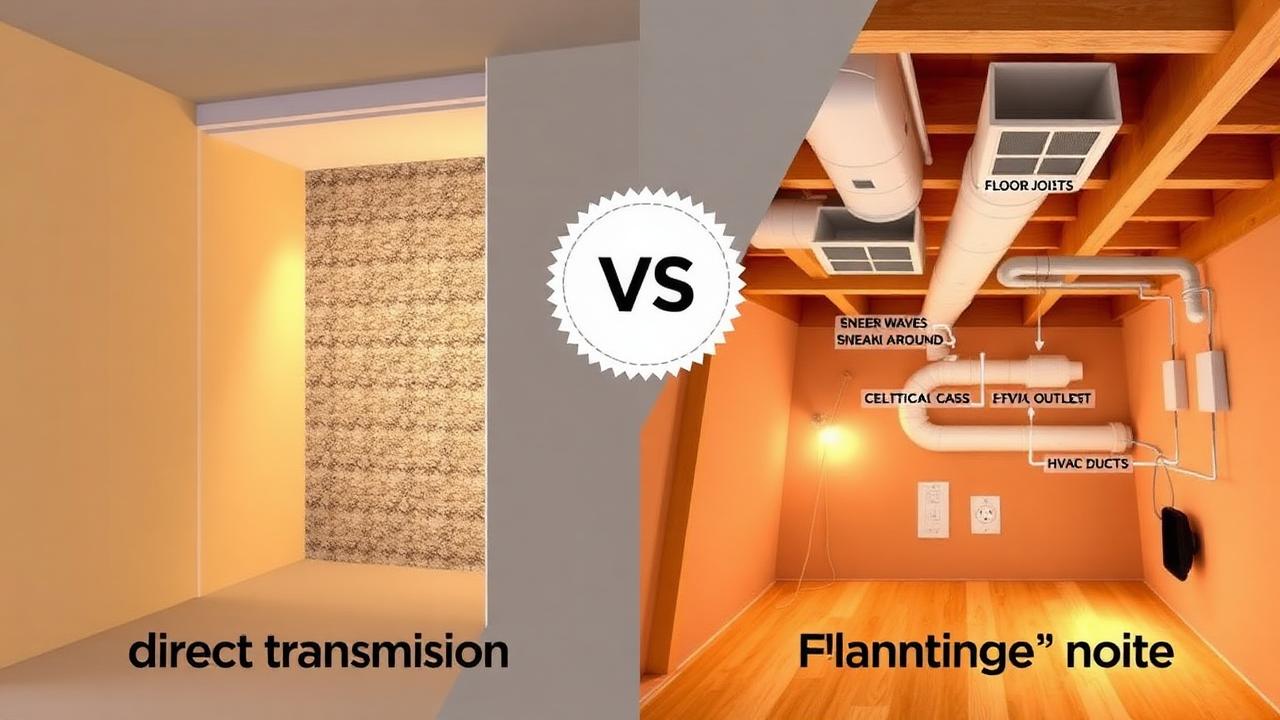
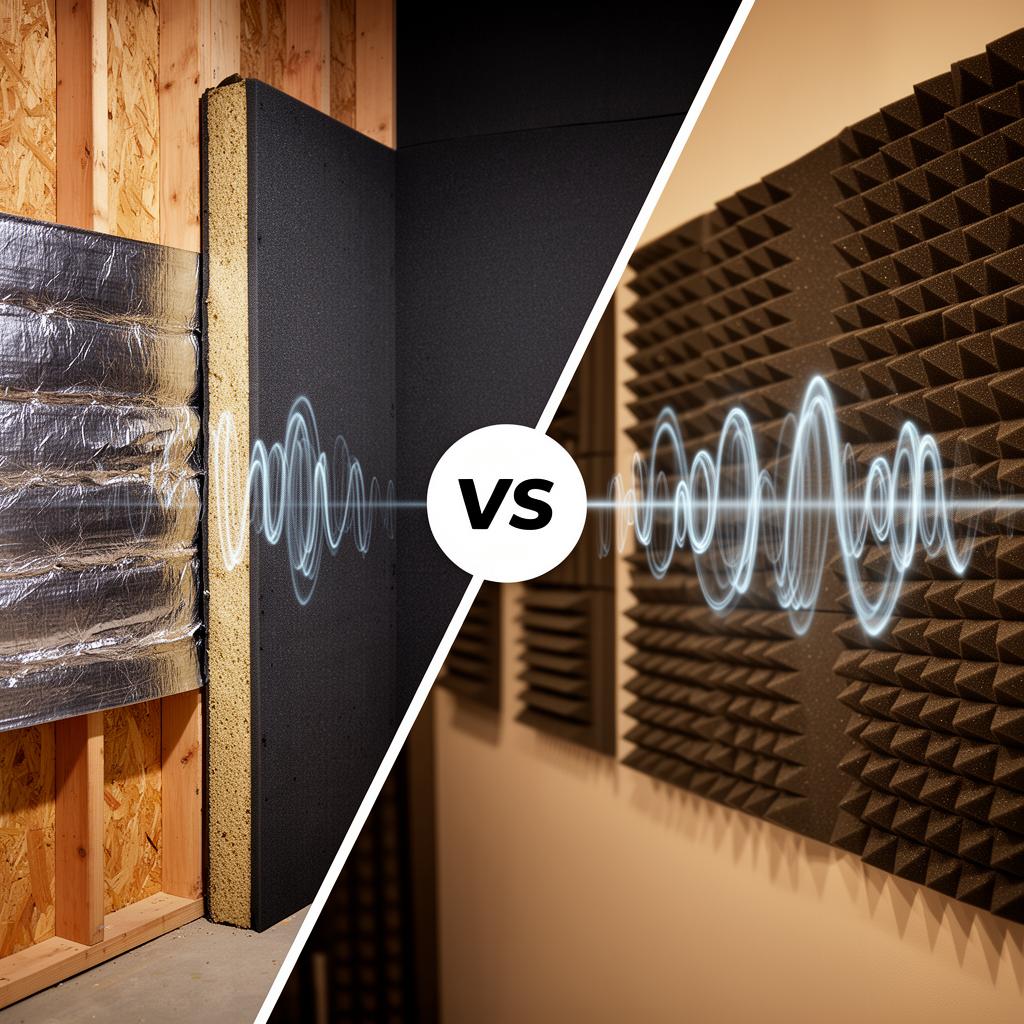
    Split-screen comparison of direct sound transmission through a wall versus flanking noise traveling through floor joists, ducts, and gaps
    Split-screen comparison of direct sound transmission through a wall versus flanking noise traveling through floor joists, ducts, and gaps

    1Why Your 'Perfect' Wall Still Leaks Sound

    Every soundproofing assembly has a theoretical maximum performance — its lab-tested STC rating. But lab tests are conducted between two isolated concrete chambers where the only path for sound is directly through the test specimen. Your home is nothing like a lab.
    In real buildings, sound has dozens of alternative paths. The wall you treated might block 55 dB of direct transmission, but if the floor beneath it only blocks 35 dB of flanking transmission, the overall noise reduction between rooms is closer to 35 dB. The weakest path dominates. Always.
    This is why people spend thousands of dollars on a party wall and feel like it did nothing. The wall itself might be performing exactly as rated — the problem is everything around it.

    2What Direct Transmission Actually Is

    Direct transmission is the straightforward path: sound waves hit one side of a wall, vibrate through the wall assembly, and radiate out the other side. This is the transmission path that STC ratings measure and that most soundproofing products are designed to address.
    Every component in the wall contributes to direct transmission:
    • The drywall layers (mass and damping)
    • The stud framing (structural vibration path)
    • Cavity insulation (absorbs airborne energy in the gap)
    • Any added mass layers like MLV (increases the barrier's weight)
    • Decoupling elements like resilient channels or isolation clips (break the structural path)
    When you add MLV, double up drywall, install isolation clips, or fill the cavity with mineral wool, you are reducing direct transmission through that specific partition. These are all legitimate, proven upgrades — but they only address sound that actually passes through the wall itself.

    3What Flanking Noise Actually Is

    Flanking transmission is any path sound takes around, over, under, or beside the partition you treated. Instead of passing through the wall, sound energy vibrates through connected structural elements or leaks through gaps that have nothing to do with the wall assembly itself.
    Think of it this way: your wall is a dam, but the river is also flowing through underground channels, over the hillside, and through pipes running beneath the dam. No matter how tall and thick you build the dam, water finds the path of least resistance. Sound behaves identically.
    Flanking paths are insidious because they are invisible. You cannot see sound traveling through a continuous concrete slab, up through shared floor joists, or along a rigid HVAC duct that connects two rooms. But the energy arriving via these paths can be louder than the direct transmission through a well-treated wall.

    4The Most Common Flanking Paths

    The following table identifies the most frequent flanking paths in residential and commercial construction and their typical impact:
    Flanking PathHow Sound TravelsSeverityCommon Fix
    Continuous floor slabVibration travels through the concrete or subfloor beneath the treated wallHighSaw-cut control joint or resilient underlayment at the wall line
    Shared ceiling joistsJoists run perpendicular to the wall and connect both rooms structurallyHighJoist isolation clips, separate ceiling framing, or resilient channel
    HVAC ductworkRigid metal ducts act as speaking tubes between roomsHighLined duct, duct silencers, or separate HVAC zones
    Back-to-back electrical boxesHoles in the drywall create direct air pathsMediumOffset boxes by one stud bay, seal with putty pads
    Gaps at wall perimeterAir leaks at the top plate, bottom plate, or wall intersectionsMediumAcoustic caulk on every perimeter edge
    Doors and windowsWeak points with much lower STC than the surrounding wallVery HighSolid-core doors, proper weatherstripping, acoustic seals
    The critical insight: upgrading the wall from STC 35 to STC 55 means nothing if a rigid HVAC duct connecting the two rooms is transmitting sound at the equivalent of STC 20. The overall isolation is governed by the worst flanking path, not the best wall treatment.

    5How to Diagnose Which Problem You Have

    Before spending another dollar on wall treatment, determine whether your remaining noise is direct or flanking transmission. Here is a simple diagnostic approach:
    The listening test: Stand in the quiet room and carefully move your ear along the wall, ceiling, floor, and around any outlets, doors, or vents. If the noise is loudest at the wall surface, you likely have a direct transmission issue. If it is loudest at the floor-wall junction, ceiling, a vent, or an outlet — you have a flanking problem.
    The pillow test: Hold a thick pillow or folded blanket against the wall where you hear the noise. If the sound drops significantly, the wall is the problem (direct transmission). If the sound barely changes, it is arriving via a flanking path — the wall is already doing its job, and the sound is coming from elsewhere.
    The room pressure test: Close all doors and windows. Hold a lit incense stick near outlet covers, light fixtures, the gap under the door, and where the wall meets the floor and ceiling. If you see smoke movement, you have air paths — and wherever air flows, sound follows. These are flanking leaks that no amount of wall mass will fix.

    6Fixing Flanking Paths Without Tearing Everything Apart

    The good news: many flanking paths can be addressed with targeted, minimally invasive treatments that cost a fraction of a full wall rebuild.
    1. Seal every air gap. Acoustic caulk along the wall perimeter — top, bottom, and side intersections — is the single highest-ROI treatment in all of soundproofing. A $10 tube of caulk can improve overall isolation by 3-5 dB by eliminating air flanking paths.
    2. Treat electrical penetrations. Install fire-rated putty pads behind every outlet and switch box on the party wall. Offset back-to-back boxes by at least one stud bay. These small openings can transmit a surprising amount of sound.
    3. Address HVAC flanking. If a duct connects the two rooms, install a lined 90-degree bend (sound trap) or a commercial duct silencer. Even wrapping the duct with 1 lb MLV for 4-6 feet on each side of the wall can reduce duct-borne flanking by 10-15 dB.
    4. Decouple the ceiling. If shared joists are the flanking path, installing resilient channel or isolation clips on the ceiling — even if you already treated the wall — can be transformative. The ceiling often flanks more noise than the wall transmits directly.
    5. Break the floor connection. A resilient underlayment or rubber isolation mat at the base of the treated wall interrupts vibration transfer through the subfloor. In concrete buildings, a saw-cut control joint in the slab at the wall line is the gold standard.
    The priority rule: Always fix air leaks first (cheapest, highest impact), then structural flanking paths (ceiling joists, floor connections), then consider upgrading the wall itself. Most people do this in reverse order and wonder why they wasted money.

    8Conclusion

    Direct transmission and flanking noise are two fundamentally different problems that require fundamentally different solutions. Treating the wall addresses direct transmission. Treating everything around the wall addresses flanking. If you have already invested in a high-performance wall assembly and still hear noise, the answer is almost never 'add more mass to the wall.' The answer is to find and fix the flanking paths — the floor, the ceiling, the ducts, the outlets, and the air gaps that are carrying sound around your expensive barrier. Identify the weakest path first, fix it, then reassess. This systematic approach saves money, avoids frustration, and delivers the quiet room you were promised.

    FAQs: Flanking Noise vs Direct Transmission

    Need Expert Soundproofing Advice?

    Our team of soundproofing specialists is here to help you choose the right products and installation methods for your museum or gallery project.