Acoustics7 min readAuthorMass Loaded Vinyl DirectPublishedUpdated

    The Acoustic History of Carnegie Hall: Why It's Considered Acoustically Perfect
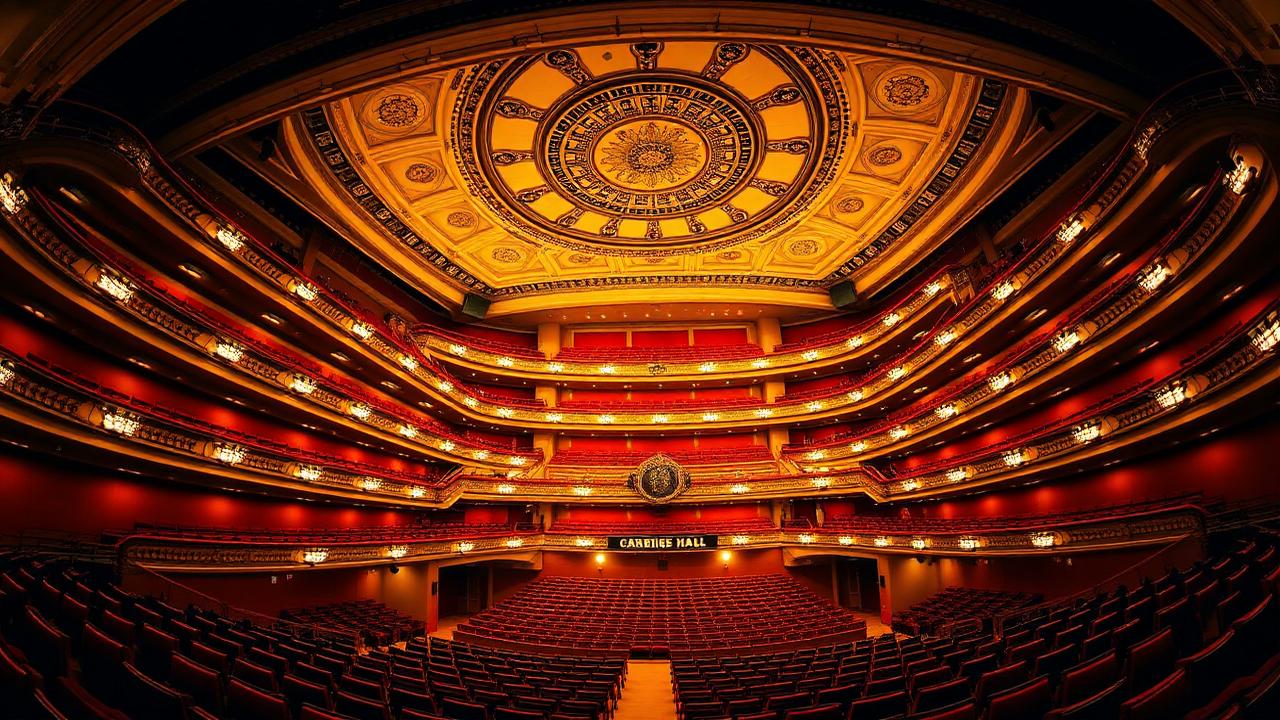
    Interior view of Carnegie Hall's iconic auditorium showing the ornate ceiling, tiered balconies, and warm golden lighting that contribute to its legendary acoustics
    Interior view of Carnegie Hall's iconic auditorium showing the ornate ceiling, tiered balconies, and warm golden lighting that contribute to its legendary acoustics

    1The Shoebox Shape: Why Rectangular Halls Sound Better

    Carnegie Hall's Isaac Stern Auditorium follows what acousticians call the "shoebox" design — a tall, narrow, rectangular room approximately 197 feet long, 98 feet wide, and 77 feet high. This shape wasn't chosen by accident. Tuthill studied the best-sounding halls in Europe, including the Musikverein in Vienna (1870) and the Concertgebouw in Amsterdam (1888), both of which share this proportional geometry.
    The shoebox shape works because of lateral reflections. In a rectangular room, sound bouncing off the side walls reaches each ear at slightly different times and angles. This creates a phenomenon called acoustic spatial impression — the feeling of being immersed in sound rather than simply hearing it from one direction. Research by acoustic scientist Michael Barron in the 1970s confirmed that lateral energy fraction (the ratio of side-reflected sound to total sound) is the single strongest predictor of how audiences rate a concert hall.
    Fan-shaped and circular auditoriums, by contrast, direct reflected sound back toward the center of the room or focus it into hot spots and dead zones. Carnegie's narrow width ensures that early lateral reflections arrive within the critical 20–80 millisecond window that the brain interprets as "spaciousness" rather than "echo."

    Key Dimensions of Isaac Stern Auditorium

    ParameterMeasurementAcoustic Significance
    Length197 ft (60 m)Provides sufficient volume for 1.8–2.0s RT60
    Width98 ft (30 m)Delivers lateral reflections within 20–80 ms window
    Height77 ft (23.5 m)Creates tall reverberant field above audience
    Seating Capacity2,804Balanced ratio of absorptive (audience) to reflective surfaces
    Volume~24,250 m³~8.6 m³ per seat — ideal for symphonic music

    2The Elliptical Ceiling and Dome: Sound Distribution Without Focusing

    The most distinctive architectural feature of Carnegie Hall's main auditorium is its arched ceiling with a shallow dome. Unlike a parabolic or hemispherical dome — which focuses sound into specific spots and creates uneven distribution — Carnegie's elliptical curve scatters reflected sound broadly across the audience.
    This diffusion effect means that a violin played at center stage sounds remarkably similar in the front row, the dress circle, and the top balcony. Musicians frequently note that Carnegie Hall "projects" sound to every seat without amplification, a quality that eludes many modern halls despite sophisticated acoustic modeling.
    The ceiling's plaster construction also contributes. Plaster on lath (the original construction method) creates a slightly flexible surface that absorbs a narrow band of low-mid frequencies while reflecting the rest. This selective absorption prevents the "boominess" that plagues halls with entirely rigid concrete ceilings, while preserving the warmth that audiences associate with Carnegie's signature sound.

    3Construction Materials: Why the Original Walls Matter

    Carnegie Hall was built with load-bearing masonry walls — thick brick and stone construction that provides enormous mass. In acoustic terms, mass is the most effective barrier to sound transmission and the most effective reflector of sound within a room. The massive walls reflect low-frequency energy back into the hall rather than letting it transmit through the structure, preserving the bass warmth that is critical for orchestral music.
    The interior surfaces combine hard plaster, ornamental ironwork, and wood detailing. Each material reflects and absorbs slightly different frequencies, creating what acousticians call a spectrally balanced decay — the reverberation doesn't favor any particular frequency range, so the sound fades evenly across the spectrum. Halls that rely on a single surface material (all concrete, all wood, all glass) tend to produce colored reverberation where certain frequencies ring longer than others.
    The original wooden stage floor, slightly raised and built over an air cavity, acts as a natural resonator that amplifies and warms the sound of acoustic instruments. Musicians consistently describe the stage as "alive" — they can feel the floor vibrating sympathetically with their instruments, providing real-time tactile feedback that improves performance.
    This combination of massive masonry walls, plaster diffusing surfaces, and a resonant wooden stage is remarkably similar to what modern acoustic engineers specify for high-performance concert halls — Tuthill arrived at the same solution 80 years before the science caught up.

    4The Near-Demolition: How Carnegie Hall Almost Disappeared

    In 1960, Carnegie Hall came within months of demolition. The New York Philharmonic had moved to the newly constructed Lincoln Center, and the hall's owners planned to replace the building with a commercial office tower. Violinist Isaac Stern — later the hall's namesake — led a public campaign that resulted in the City of New York purchasing the building and designating it a National Historic Landmark in 1962.
    The near-demolition is acoustically significant because it highlights how irreplaceable the hall's sound is. When Lincoln Center's Philharmonic Hall (now David Geffen Hall) opened in 1962, it was immediately criticized for poor acoustics despite being designed by leading acoustician Leo Beranek. The hall underwent multiple renovations over six decades — in 1976, 1992, and most recently a $550 million reconstruction completed in 2022 — before achieving acoustics that critics consider acceptable.
    Carnegie Hall's acoustics, by contrast, required no such intervention. The original 1891 design worked from opening night. This comparison illustrates a humbling reality in architectural acoustics: even with modern science, replicating the sound of a great hall is extraordinarily difficult.

    5Renovation Controversies: The 1986 Concrete Incident

    In 1986, a major renovation added a concrete slab beneath the stage to support a new commercial space (Zankel Hall) below. Musicians immediately reported that the stage felt "dead" — the resonant quality of the original wooden floor over its air cavity had been destroyed by coupling it to a massive concrete foundation.
    The acoustic change was subtle but significant. The stage no longer vibrated sympathetically with instruments, reducing the tactile feedback performers relied on. Critics debated whether the change affected the audience experience or only the performer's perception, but the consensus among musicians was clear: something essential had been lost.
    In 1995, the concrete was removed and the original air cavity restored. Musicians reported an immediate improvement, confirming that the stage floor's resonant properties were integral to the hall's acoustic character. This episode became a landmark case study in architectural acoustics, demonstrating that even well-intentioned structural changes can have devastating acoustic consequences.
    The lesson for modern builders is direct: acoustic performance depends on the entire structural system, not just surface treatments. Adding mass to a floor for structural purposes can destroy the resonant properties that make a space sound exceptional.

    6The Science Behind the Sound: Measurable Perfection

    Modern acoustic measurements confirm what musicians and audiences have described for over a century. Carnegie Hall's Isaac Stern Auditorium consistently produces metrics in the optimal range for symphonic music:

    Acoustic Measurements

    MetricCarnegie HallOptimal RangeWhat It Means
    RT60 (Reverberation Time)1.8–2.0 seconds1.7–2.2 secondsHow long sound takes to decay by 60 dB
    Early Decay Time (EDT)~1.9 seconds1.8–2.1 secondsPerceived reverberance — how "live" the room feels
    Clarity (C80)-1 to +1 dB-2 to +2 dBBalance between direct sound and reverberant energy
    Lateral Energy Fraction~0.250.15–0.35Spatial impression and envelopment
    Stage Support (ST1)-12 to -14 dB-11 to -15 dBHow well musicians hear each other on stage
    What makes these numbers remarkable is not any single metric — many modern halls hit individual targets. It's that Carnegie Hall achieves optimal values across every parameter simultaneously. Most halls sacrifice one quality for another: a very reverberant hall may lack clarity, or a clear hall may feel dry and intimate rather than enveloping. Carnegie's geometry produces the rare combination of warmth, clarity, spaciousness, and balance that defines acoustic perfection.
    The hall's volume-per-seat ratio of approximately 8.6 cubic meters is also significant. Acoustic research has established that symphonic halls perform best between 8 and 11 cubic meters per seat. Too little volume and the sound feels cramped and over-bright; too much and the reverberation becomes washy and undefined.

    7What Modern Builders Can Learn from Carnegie Hall

    Carnegie Hall's enduring acoustic excellence offers several principles that apply to any construction project where sound quality matters — from home theaters and recording studios to offices and multifamily housing:
    Mass matters most. Carnegie's thick masonry walls are its acoustic foundation. In modern construction, mass loaded vinyl (MLV) provides the same principle in a practical format — adding dense, flexible mass to wall and ceiling assemblies to block sound transmission without the structural requirements of solid masonry.
    Geometry shapes sound. Room proportions determine where reflections arrive and how they interact. Parallel walls create flutter echo; non-parallel or diffusing surfaces distribute sound evenly. Even in residential construction, avoiding perfectly square rooms and adding diffusing elements improves acoustic comfort.
    Multiple materials outperform single materials. Carnegie's combination of masonry, plaster, wood, and iron creates spectrally balanced acoustics. In soundproofing, layered assemblies — drywall, MLV, Green Glue, and a second layer of drywall — outperform any single material because each layer addresses different frequencies and transmission mechanisms.
    Structural connections transmit sound. The 1986 concrete incident proved that rigid connections between a performance surface and its substructure can destroy acoustic quality. Decoupling — using resilient channels, isolation clips, or floating floors — prevents structure-borne sound from traveling through a building.
    Great acoustics resist modification. Once a space achieves acoustic excellence, even minor structural changes can compromise it. This argues for getting the acoustic design right during initial construction rather than attempting to fix problems after the fact.

    10Conclusion

    Carnegie Hall stands as proof that acoustic perfection is not a product of technology — it is a product of proportion, mass, material diversity, and an almost instinctive understanding of how sound behaves in enclosed spaces. William Burnet Tuthill designed the hall before the science of acoustics existed, yet his creation outperforms venues designed with every modern tool available. For anyone building or renovating a space where sound matters, Carnegie Hall's lessons are clear: start with the right geometry, add sufficient mass, use diverse materials, decouple structural connections, and resist the temptation to modify what works. The principles that made Carnegie Hall acoustically perfect in 1891 are the same principles that make mass loaded vinyl, resilient channels, and layered wall assemblies effective today.

    FAQs: Carnegie Hall Acoustics

    Need Expert Soundproofing Advice?

    Our team of soundproofing specialists is here to help you choose the right products and installation methods for your museum or gallery project.