Materials7 min readAuthorMass Loaded Vinyl DirectPublishedUpdated

    The Best Materials for Treating Flutter Echo in a Room
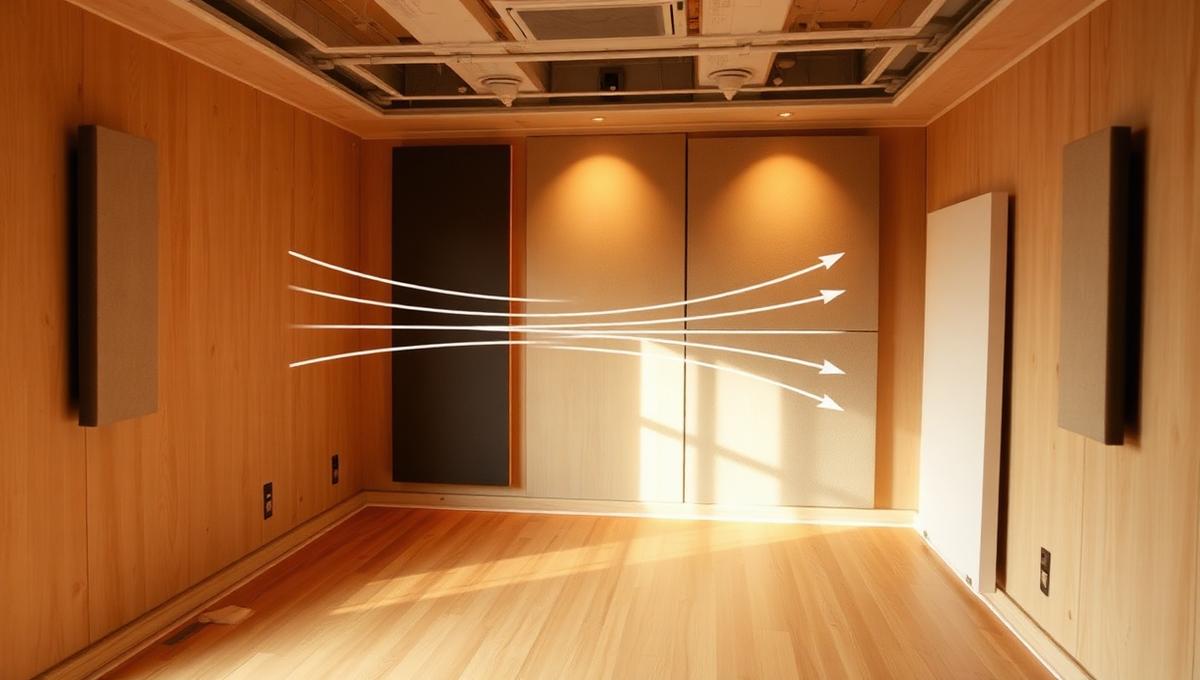
    Interior room showing acoustic treatment panels and diffusers installed on parallel walls to eliminate flutter echo
    Interior room showing acoustic treatment panels and diffusers installed on parallel walls to eliminate flutter echo

    1What Flutter Echo Is and Why It Happens

    Flutter echo occurs when sound waves bounce back and forth between two parallel, reflective surfaces — typically opposite walls, or a floor and ceiling. Each reflection arrives at your ear in rapid succession (usually 20-50 ms apart), creating a distinctive "pinging" or "zinging" quality that is clearly distinguishable from normal room reverb.
    Three conditions must exist simultaneously for flutter echo to occur:
    Parallel surfaces: Two flat, smooth surfaces directly facing each other with no angle or offset
    Reflective materials: Hard surfaces like drywall, glass, concrete, tile, or hardwood that reflect rather than absorb sound energy
    Appropriate distance: Surfaces between 4-30 feet apart — close enough for reflections to arrive as distinct repetitions rather than blending into reverb
    Small rooms are particularly vulnerable because the short distance between parallel walls creates fast, tight reflection patterns that the ear perceives as a tonal artifact rather than spaciousness. Conference rooms, home studios, podcasting spaces, bathrooms, and hallways are the most common victims.

    2How to Confirm You Have Flutter Echo

    Before spending money on treatment, confirm the problem is actually flutter echo and not general reverberation or room resonance. The test is simple:
    The Clap Test: Stand in the center of the room and clap sharply once. Listen for a rapid, ringing decay — it sounds like a short "sproing" or metallic buzz lasting 0.5-2 seconds. Walk around the room and clap in different positions. Flutter echo is typically loudest near the center of the room, equidistant from both parallel surfaces.
    The Talk Test: Stand between two parallel walls and speak normally. If your voice sounds "colored" — like it has a slight metallic edge or pitch shift — flutter echo is likely adding unwanted artifacts to the sound. Record yourself speaking on your phone from the room center. On playback, the flutter artifacts are often more obvious than they are in real-time.
    If you hear a smooth, even decay without ringing or pinging, your problem is general reverberation (excessive RT60), which requires different treatment strategies. Flutter echo is distinctly repetitive — you can almost count the individual reflections.

    3The 6 Best Materials for Treating Flutter Echo

    1. Fabric-Wrapped Fiberglass Panels (Best Overall)

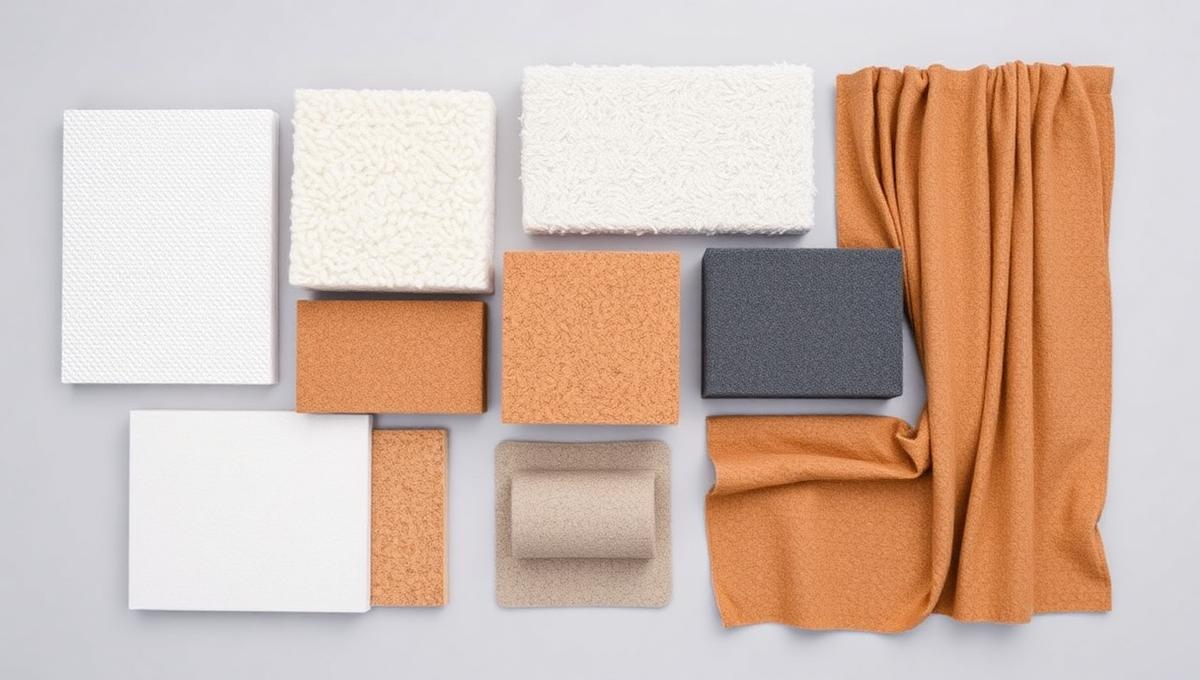
    Rigid fiberglass panels (Owens Corning 703 or equivalent) wrapped in acoustically transparent fabric are the gold standard for flutter echo treatment. At 2 inches thick, they achieve NRC 0.85-1.05, absorbing the mid and high-frequency energy that drives flutter echo.
    Why they work: Fiberglass panels convert sound energy to heat through friction as air molecules pass through the dense fiber matrix. Placed on one or both parallel surfaces, they break the reflection cycle completely.
    Cost: $30-60 per 2×4-foot panel (DIY) or $80-150 pre-made
    Best for: Home studios, podcast rooms, conference rooms, home theaters

    2. Acoustic Diffusers (Best for Music Rooms)

    Diffusers scatter sound energy in multiple directions rather than absorbing it. QRD (Quadratic Residue Diffuser) and skyline-type diffusers break up the parallel reflection path without removing energy from the room — preserving liveliness while eliminating flutter.
    Why they work: By redirecting reflections at varying angles and times, diffusers prevent the coherent back-and-forth bouncing that creates flutter echo. The room retains energy and feels "live" without the metallic ringing.
    Cost: $80-300 per panel depending on size and material
    Best for: Music practice rooms, recording studios, listening rooms where you want ambience without flutter

    3. Mineral Wool Panels (Best Budget Option)

    Rockwool or Roxul Safe'n'Sound mineral wool batts achieve NRC 0.80-0.95 at 2-inch thickness and cost significantly less than pre-made acoustic panels. Frame them in simple 1×3 lumber with fabric stapled over the front for professional-looking DIY panels.
    Why they work: Dense mineral fibers absorb broadband frequency energy effectively. The higher density compared to fiberglass (8 lbs/ft³ vs. 3 lbs/ft³) provides slightly better low-mid absorption.
    Cost: $15-30 per 2×4-foot panel (DIY framing + fabric)
    Best for: Budget-conscious home studios, basement rooms, garage conversions

    4. Heavy Curtains and Acoustic Drapes

    Heavyweight curtains (velvet, wool, or purpose-built acoustic curtains at 1+ lb per square foot) provide meaningful absorption at mid and high frequencies. They are the fastest, most reversible treatment option for flutter echo.
    Why they work: The thick, pleated fabric surface absorbs and scatters incoming sound waves. Hung 4-6 inches from the wall with deep pleats, curtains can achieve NRC 0.40-0.75 depending on weight and fullness.
    Cost: $50-200 per window/wall section
    Best for: Rental spaces, temporary setups, conference rooms, bedrooms with hard parallel walls

    5. PET Felt Acoustic Tiles

    Made from recycled plastic bottles, PET felt panels are lightweight, easy to mount, and available in decorative colors and patterns. At 9mm-12mm thickness, they achieve NRC 0.30-0.55 — enough to treat flutter echo when used in sufficient coverage.
    Why they work: The compressed fiber structure absorbs mid and high-frequency reflections. While less effective per square foot than fiberglass, their decorative appeal makes them ideal for visible office and residential installations.
    Cost: $8-20 per square foot installed
    Best for: Open offices, modern residential spaces, anywhere aesthetics matter as much as acoustics

    6. Carpet and Thick Rugs (Floor-Ceiling Flutter)

    When flutter echo occurs between a hard floor and a flat ceiling — common in apartments, lofts, and basements — a thick area rug or wall-to-wall carpet eliminates the floor reflection. A rug with a dense pad underneath achieves NRC 0.30-0.55 for the floor surface.
    Why they work: By absorbing the floor-bounce reflection, carpet breaks the vertical flutter path without requiring ceiling treatment. This is the simplest, fastest fix for floor-ceiling flutter.
    Cost: $2-8 per square foot for quality area rugs
    Best for: Apartments, living rooms, bedrooms, any space with hard floors and flat ceilings

    4Material Comparison Table

    MaterialNRC RangeCost/sq ftDIY FriendlyRemoves Energy?
    Fiberglass Panels (2")0.85-1.05$4-8YesYes
    Mineral Wool Panels (2")0.80-0.95$2-5YesYes
    Acoustic DiffusersN/A (scatters)$10-40ModerateNo (redirects)
    Heavy Curtains0.40-0.75$5-15Very EasyPartially
    PET Felt Tiles0.30-0.55$8-20Very EasyPartially
    Carpet/Thick Rugs0.30-0.55$2-8Very EasyPartially
    Key insight: You do not need to cover every surface. Treating just one of the two parallel surfaces with an NRC 0.80+ material is usually sufficient to eliminate flutter echo. The reflection cycle requires both surfaces to be highly reflective — remove one mirror and the ping-pong effect stops.

    5Placement Strategy: Where to Put Treatment

    Effective flutter echo treatment follows a simple principle: break the parallel reflection path. You do not need to treat every wall — just enough surface area on one or both of the offending parallel surfaces to disrupt the coherent reflection.
    Wall-to-wall flutter: Place absorptive panels at the first reflection points on one wall. For a typical 10-15 foot room, two to four 2×4-foot panels at ear height on one wall eliminates the problem. If you want to preserve some room energy, use a diffuser on the opposite wall instead of absorption on both.
    Floor-to-ceiling flutter: Add a thick area rug (with pad) covering at least 50% of the floor area between the parallel surfaces. If the ceiling is accessible, a single row of ceiling-mounted cloud panels at the room center is also effective.
    Coverage guidelines: As a rule of thumb, treating 25-40% of one parallel surface area eliminates flutter echo in most rooms. A 12×12-foot room with wall-to-wall flutter needs approximately 30-50 square feet of treatment on one wall — roughly four to six 2×4-foot panels.
    Air gap matters: Mount panels with a 1-2 inch air gap between the panel and wall surface. This air gap acts as additional absorption depth, improving low-mid frequency performance by 15-30% without increasing panel thickness. Use furring strips, Z-clips, or impaling clips to create the gap.

    6Common Mistakes That Make Flutter Echo Worse

    1. Using thin foam tiles: The 1-inch acoustic foam tiles sold on Amazon for $20/pack absorb only high frequencies (above 2 kHz). They remove the "sizzle" from flutter echo but leave the lower-frequency components intact — the result is flutter that sounds duller but is still clearly present. Use minimum 2-inch thick absorbers.
    2. Treating the wrong surfaces: If flutter echo occurs between the east and west walls, placing absorption on the north wall does nothing. Identify the parallel pair causing the problem (use the clap test while standing between different wall pairs) and treat those specific surfaces.
    3. Symmetrical over-treatment: Covering both parallel walls entirely with absorption creates a dead, uncomfortable room. Treat one wall with absorption and the opposite with diffusion — or treat only 30-40% of one wall. The goal is to eliminate flutter, not remove all reflections.
    4. Ignoring corners: Bass traps in room corners do not directly address flutter echo (which is primarily a mid/high-frequency phenomenon), but they do reduce overall room resonance that can mask or interact with flutter artifacts. A complete treatment plan addresses both.
    5. Hanging treatments too high or too low: For speech and music, flutter echo treatment should be centered at ear height — approximately 3-5 feet above the floor for seated listeners, 4-6 feet for standing. Panels placed near the ceiling address only overhead reflections.

    7When Flutter Echo Requires Soundproofing Instead

    Flutter echo is an internal acoustic problem — sound bouncing within your room. It is solved with absorption and diffusion. However, if your room also has noise entering from outside (traffic, neighbors, mechanical systems), acoustic treatment panels will not help with that problem.
    Sound transmission through walls requires mass and isolation — materials like mass loaded vinyl (MLV), additional drywall layers, and resilient channel systems that block sound from passing through the wall assembly. These are soundproofing strategies, distinct from acoustic treatment.
    Many rooms need both: soundproofing to keep external noise out, and acoustic treatment to control internal reflections. In a home studio, for example, you might install MLV behind drywall to block neighbor noise (soundproofing) and fiberglass panels on the interior surface to eliminate flutter echo (acoustic treatment). The two approaches work together but address fundamentally different problems.
    If you are dealing with both external noise and flutter echo, address soundproofing first. Adding mass to walls (even with MLV directly on studs behind drywall) creates a denser, heavier surface that also slightly reduces internal reflections — giving you a head start on flutter treatment.

    9Conclusion

    Flutter echo is caused by sound bouncing between parallel reflective surfaces, and the fix is straightforward: break the reflection path with absorptive or diffusive materials on one or both surfaces. Fiberglass and mineral wool panels offer the best performance per dollar. Diffusers preserve room energy while eliminating flutter. Heavy curtains and carpet provide quick, reversible solutions. Treat 25-40% of one offending surface at ear height, mount panels with an air gap, and avoid the temptation to over-treat. With the right materials and placement, you can eliminate flutter echo in an afternoon.

    FAQs: Flutter Echo Treatment Materials

    Need Expert Soundproofing Advice?

    Our team of soundproofing specialists is here to help you choose the right products and installation methods for your museum or gallery project.